The Station That Learned to Wait
20261106T065641053096Z_100percent.png
Story
THE STATION THAT LEARNED TO WAIT
Velth Hollow, in the Age Before Earth
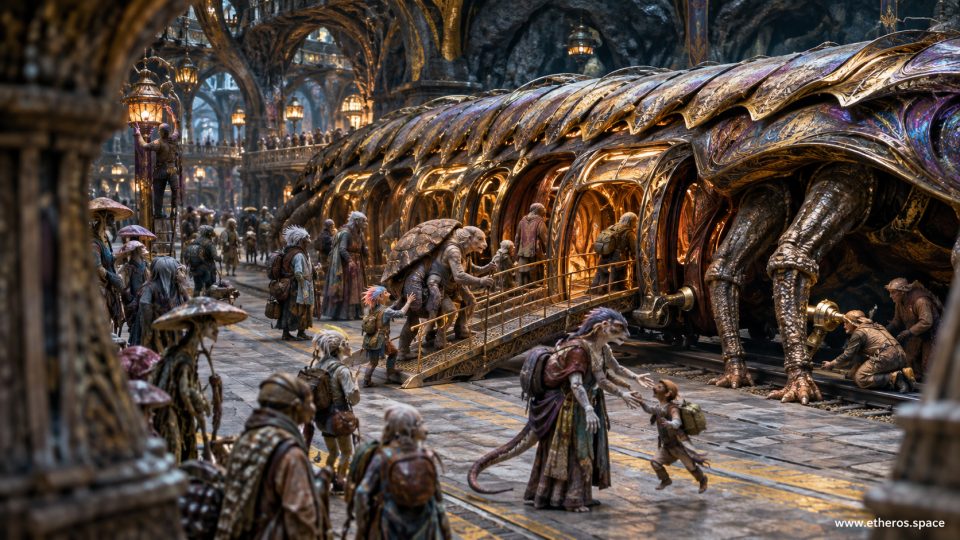
Beneath the dry northern hills, where the roots of old towers reached into blue-black rock, the Underway had never been entirely quiet. Lanterns swayed above its platforms, porters called across stone balconies, and beneath every voice came the low, rhythmic weight of Namar. The enormous plated carrier rested with jointed feet on the reinforced track bed, its curved shell enclosing a chain of amber-lit passenger chambers. Its body was alive, but the passageways and handrails had been built by generations of smaller hands.
This shift, the departure bell had already been delayed twice.
Darruk was halfway up the brass-railed boarding ramp. His broad shell rubbed the side rail as he negotiated the incline. He had brought only one small traveling bundle. A young orange-crested relative beside the ramp, Seli, lifted a hand to encourage him, but Darruk kept his attention on the landing. He was old enough to distrust promises that a journey would be easy.
Beyond the ramp a child named Ivi came running across the marked paving, a small pack dancing on her shoulders. Talan, waiting with a long tail curved around her feet, stretched both arms toward her. They had missed each other during the previous work season. Their reunion happened amid the impatient shuffle of strangers, not beneath any ceremonial arch. Nearby, a ladder worker adjusted a lamp above the crowd, while Vem knelt beside one of Namar's thick front limbs, testing the stone-and-brass collar that distributed its load into the track.
The station keeper, Orvek, watched the departure markers without raising a whistle. Namar could travel when ready, but starting with a passenger still on the ramp risked a stumble; forcing the creature to hold its weight in the same stance too long strained its working joints. Earlier keepers had solved the problem by refusing late or slow travelers. Their ledgers showed commendably punctual departures. They did not record the journeys never made.
A commission from the upper galleries had ordered Orvek to shorten the dwell between bells. The next term's classroom supplies, freight tools and apprentice placements depended on a reliable line through Velth; everyone who waited had someone elsewhere who also waited. Merchants complained that two extra minutes at every stop became a lost shift by nightfall. Families answered that a timetable fit for the quick-footed was not, by itself, a public road.
Orvek went down to the ramp rather than speak from the bridge. Darruk was nearly at the top. He did not ask for another's arm. He asked whether the landing could be leveled; the final lip was higher than he had been told. The metalworker on the platform knew the problem. A repair plate added after a fracture had been shaped for narrow feet, leaving shell-bearers to angle their bodies sideways. The rail was strong; the entry was poorly measured.
So Orvek held the departure and made a different calculation. Vem checked the carrier's posture, then signaled that its weight could be shifted safely onto a second pair of braced limbs. A portable beveled plank was carried to the chamber threshold. It was not a permanent repair, and nobody pretended that it was. Darruk tested it once, then climbed into the light without being pulled.
Seli grinned, but Darruk looked back at the crowded floor. 'Keep the plank here for the next traveler,' he said. It was a small instruction. It was also one that would cost the station something: a carpenter's hours, a changed inspection routine, and a little storage beside every doorway.
Ivi finally reached Talan, breathless and laughing, and they embraced so suddenly that both nearly stepped beyond the yellow guide marks. A porter pointed them gently toward the safe edge. There was kindness in the warning. There was also the practical knowledge that no reunion, however long delayed, should take place beneath the foot of a moving creature.
The third bell rang. Namar flexed, slowly transferring its great weight along the supported track. Lanterns trembled in their frames. Up above, Orvek entered the additional boarding interval in the public log instead of hiding it among mechanical faults. He marked the repair plate for review and asked the lamp worker to check whether the ramp could be seen clearly from the far side of the platform.
That evening the freighters would argue over the lost minutes, and the station council would have to decide whether all its boarding platforms could be altered before the teaching season. The line could not afford endless delays. Neither could its people afford a road that made some of them strangers in their own world.
For one departure, at least, the bell rang only after the last traveler had found a place. The carrier moved. The child held her parent's hand. And in the stone below Velth, a promise became a measurement that someone might someday be required to keep.