The Path That Only Wings Could See
20261106T052520907254Z_066percent.png
Story
THE PATH THAT ONLY WINGS COULD SEE
Ashveil's Westward Notch, in the Age Before Earth
At dusk the mountain opened, and everything with wings tried to pass through it.
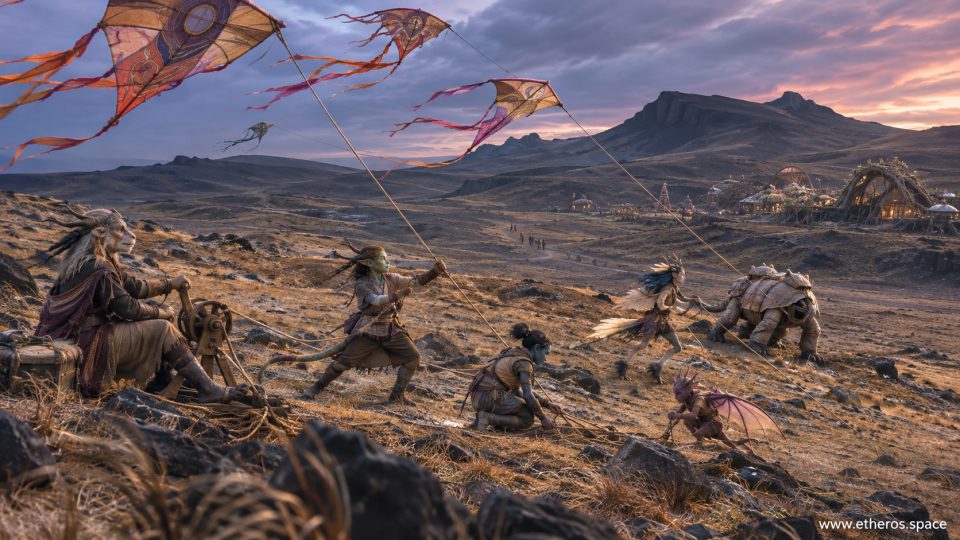
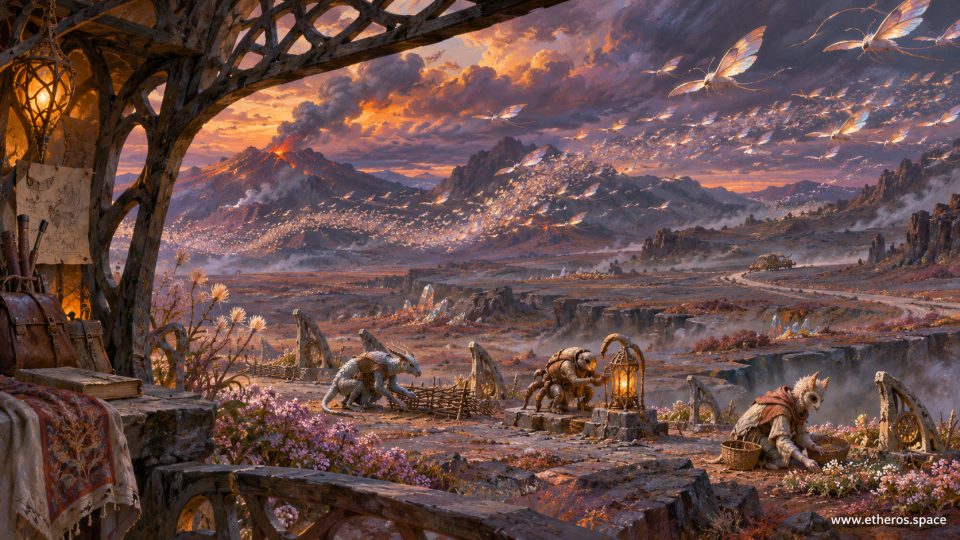
The great ash ridge had smoked all afternoon. By the time the western sky turned copper, its plume had stretched across the valley like a second mountain, one that shifted whenever the high wind changed direction. Beneath it lay the old stone terraces of Ashveil: low flowering beds, etched waystones, black clefts, and a narrow road that climbed toward a distant wagon shelter. A few lanterns shone along the road. Above them, more lights appeared than the ground could ever have carried. Thousands of migrating glasswings came streaming between the peaks, silver membranes catching the sinking sun.
From the observatory porch, three keepers watched from different heights. Issa, whose low six-limbed body was built for gripping volcanic rock, was repairing a reed fence at the left edge of the garden. The fence did not hold the winged animals captive; it kept loose roadside dust from burying the fragile bloom beds. Near the stone waymarks, Naleth, a short broad-shelled elder, worked at a hooded amber lantern. On the right, Piri, a young pale-furred gardener with pointed ears, knelt among white and violet flowers, setting fresh stems into the black soil with a basket close at hand.
None of them had expected so many glasswings. Ashveil's old count was a line of scratches on the observatory lintel. Once each season, someone added a mark for the densest stream seen at sunset. This year, before dusk was over, the migrating ribbon covered the familiar stars and stretched back into the smoke. It might be a recovery after several lean seasons. It might be a different route caused by the warm wind. It might simply mean that, for once, somebody had looked at the right hour.
'We do not know which,' Naleth said. He turned the lantern's curved brass hood until its beam fell across the path instead of into the open air.
Issa had been arguing with him since morning. The road above the garden was the only safe evening route for the freight carts, and a cliff path without raised lights had already cost one traveler a leg. Naleth wanted darker skies for the passage. Issa wanted lamps bright enough that tired drivers could read broken edges before a wheel slipped. Neither position was foolish. The road was inhabited. So was the air above it.
Piri heard the disagreement from the flower bed. She had come to Ashveil only four days earlier, and did not yet know which names belonged to the plants or which of their seeds remained asleep beneath the rock. The white blossoms opened at sundown. They drew small ground moths, but the great glasswings passed far higher, only briefly lowering when the plume crossed their route. Piri offered no theory. She held a flowering stem steady while a cloud of powdery ash settled on her sleeve, and counted the insects that actually touched the blossoms.
'Not one of the large ones yet,' she said.
It was such a small fact that it felt almost indecent to offer it against that magnificent sky. Yet Naleth nodded. He had spent most of his life recording things whose first importance was that they resisted a good story. Some visitors claimed the planet sent each flock to repair the volcanic land. Others insisted the glasswings were escaping a catastrophe somewhere beyond the eastern range. Neither explanation could be measured from this terrace, and neither was owed the dignity of a fact merely because it sounded beautiful or terrible.
Down the road, a far-off carriage rolled along a pale curve between two dark shelves. It did not stop. The keeper on duty had to decide before the last sunlight left the stones. Naleth lowered two forward-facing lamps and raised three shielded markers close to the path, where their warm light reached feet and wheels without painting the sky. Issa inspected each bracket, pressed her weight against the fence posts, and marked the edge where a traveler could stumble. Piri placed the next flower bed farther from the stone road, where drifting dust was thinner. None called the changes a cure. For one evening they were simply measures that could be watched and improved.
An immense wave of glasswings passed overhead, turning from gold to violet as the sun slipped behind the smoke. Their wing edges flickered in the falling light; their direction held. Piri stopped planting. Issa leaned back from her woven fence. Naleth remained beside his lamp, one hand steadying its little door. For a moment the three were as quiet as the distant mountains.
When the last bright band had crossed the notch, the road was still visible. No glasswing lay at the lanterns. That proved neither the safety of every lamp nor the wisdom of every choice. Tomorrow they would count again. They would ask the upper roadkeepers whether the new markers had helped, and the growers whether the flowers could survive the ash. The ledger would have space for failures and for contradictory accounts. Its page was not an altar.
Piri looked at the unfenced sweep of sky and understood something the older keepers had not been trying to teach: a path can belong to those who never built it. The valley had been shaped by heat, stone and living roots long before any of their small settlements. Care was not ownership. Care meant making room, then returning to see whether the room had been enough.
Across Ashveil the lanterns burned low, and the dark between the mountains filled with wings too far away to count.