The Plate the Earth Could Spare
20261106T172621690313Z_066percent.png
Story
THE PLATE THE EARTH COULD SPARE
Thren Basin, the eastern salvage verge of primordial Etheros
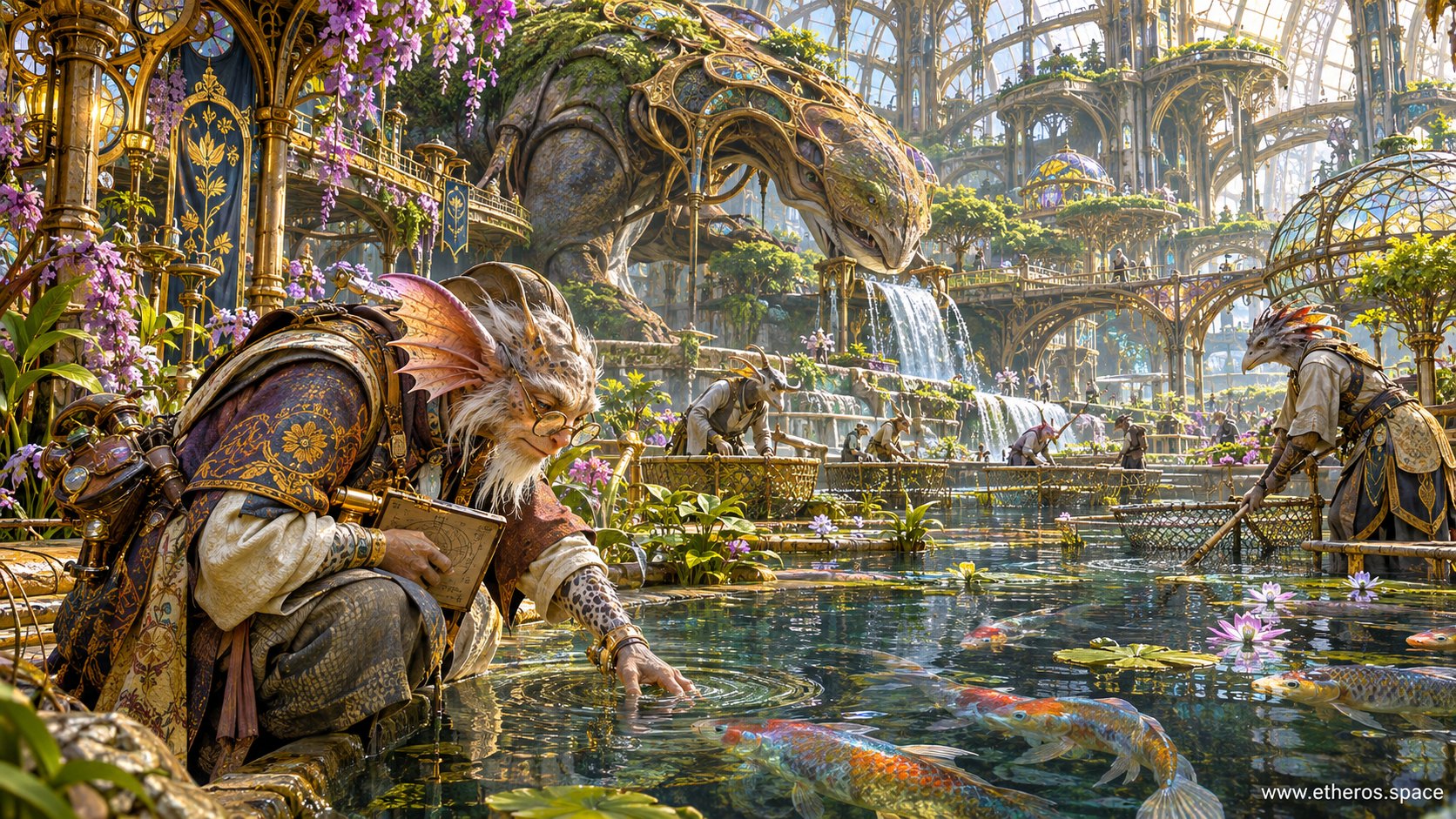
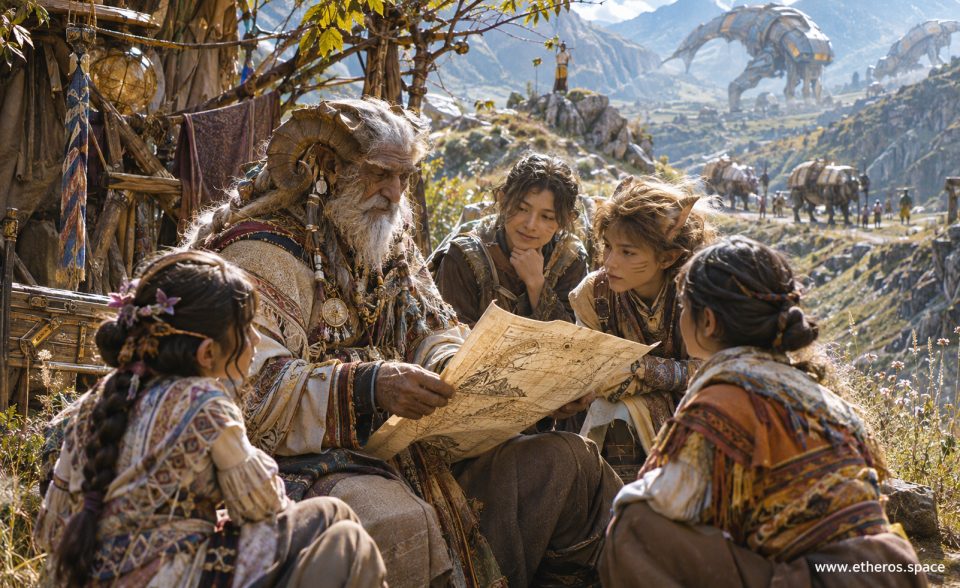
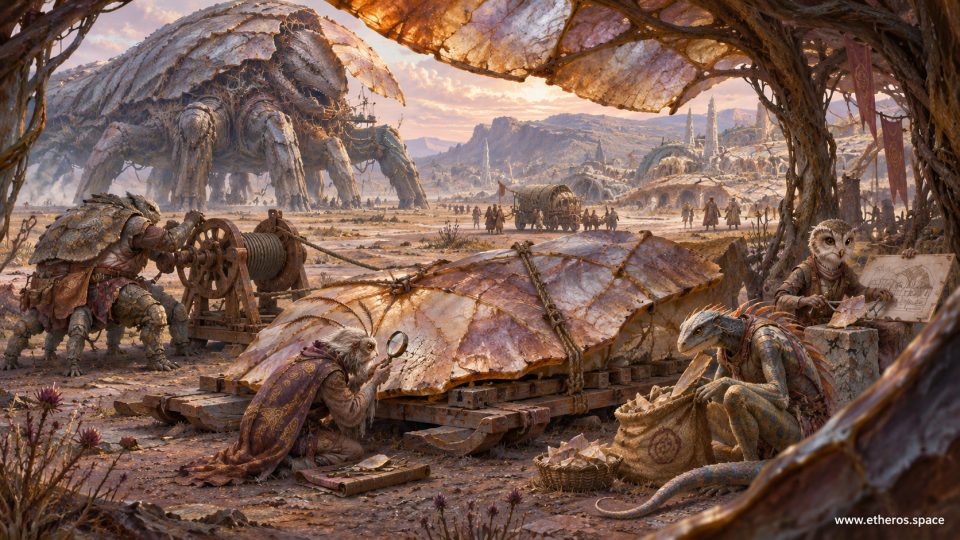
At dawn, the old carrier stood beyond the work yard, great as a quarter of the city and almost the same color as the hills. Beneath its ribbed upper armor, the morning wind traveled through living chambers that had once warmed a dozen outlying villages. Its legs rested in the dry plain, each joint supported by a web of bone, mineral and patient muscle. A road wound between the carrier and the pale stone settlement; small wagons crept along it, carrying people who had never spoken to one another but depended on the same animal.
Closer to the shelter, a slab lay across a timber sledge. Amber shone through its fractured edges. Old purple veins ran under a surface textured like weathered glass. It had separated from the carrier's outer mantle the previous evening, after a season of slow mineral loosening. That history belonged to the salvage crew's account, not to anything a stranger could read from the slab alone. The creature still walked, fed from the living plain and chose its routes; nobody here had permission to pry its armor away before it was ready.
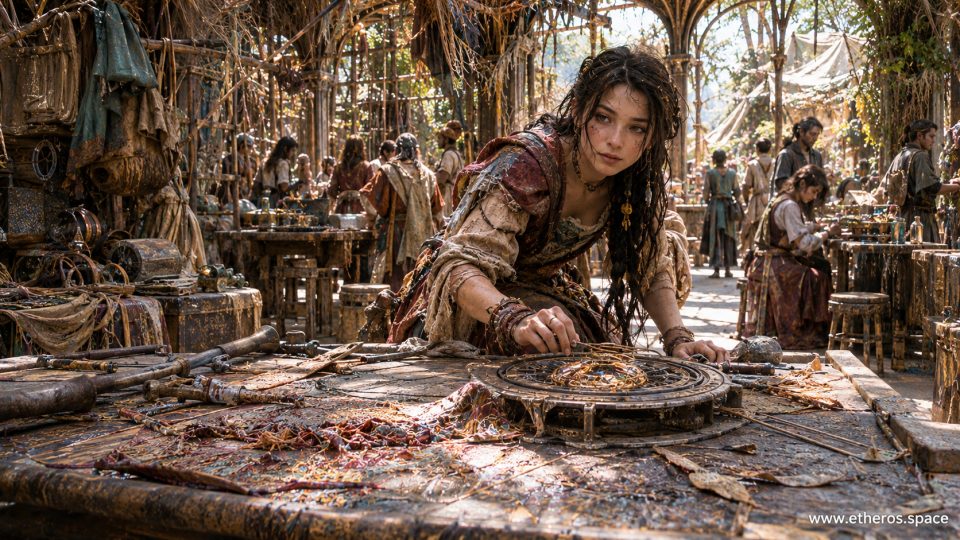
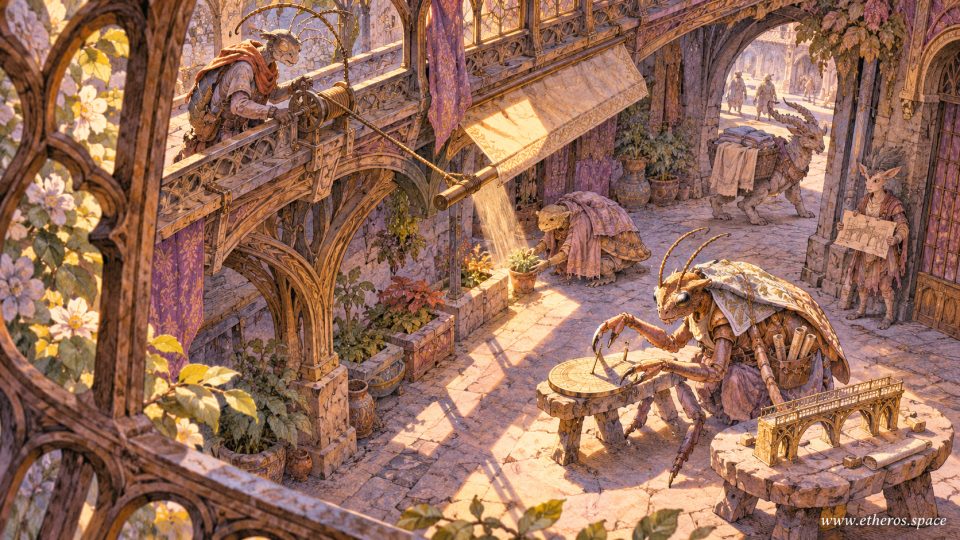
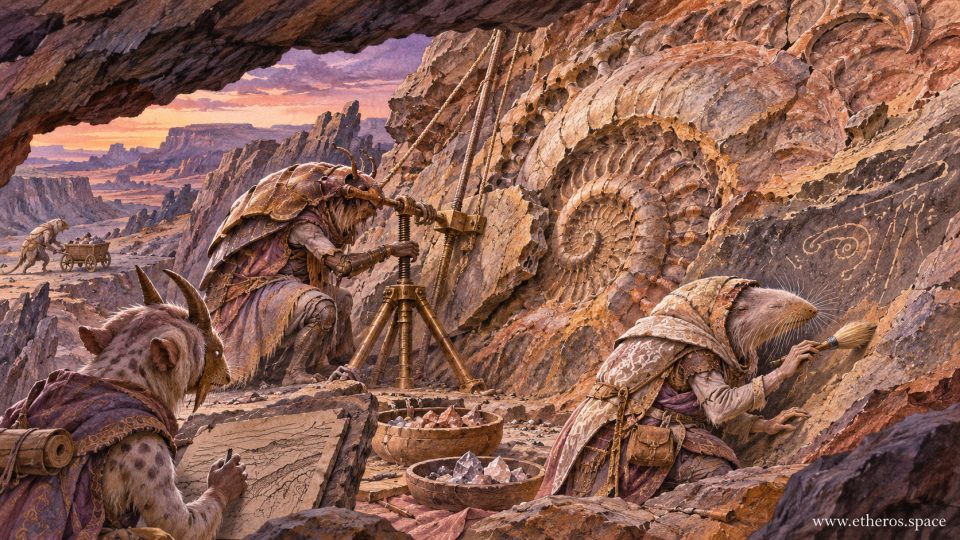
Kezha planted her rear feet against the grit and turned the winch. The shell-backed rigger's two lower gripping limbs steadied the wooden frame while her upper arms worked the wheel. Every small turn tightened the cable that held the slab level over its supports. The material did not float. If a strand broke, it would crush the sledge and anyone foolish enough to stand beneath the lip. She called the tension aloud for the others to hear.
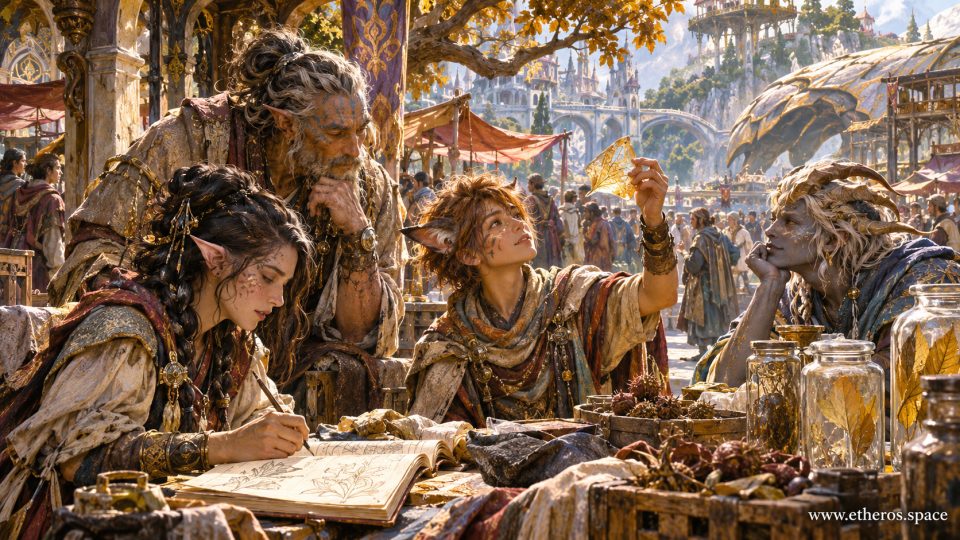
Orlin, whose soft antennae had whitened with age, crouched by the forward edge with a magnifying lens. To a passing merchant he might have seemed to be admiring the beautiful material. In fact he was counting lines of weakness. A red-brown seam stopped just short of a translucent blue one. If the two touched under load, the slab would fail in a direction no one could predict.
'It would make a fine roof,' Vask said. The scaled, long-tailed apprentice sat beside a sack of smaller flakes, sorting sharp fragments from rounded ones. 'A roof for somebody who could pay.'
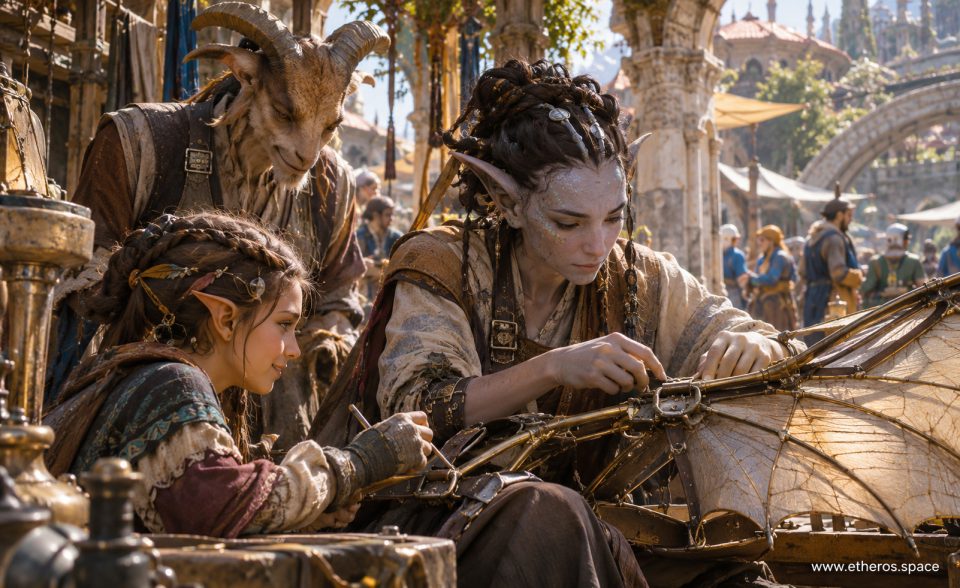
'Or four smaller roofs,' answered Feru, the feather-crested planner at the drawing board. Her map showed dwellings along the upper terraces where winter sunlight vanished early behind the arches. Each had waited through three seasons for a heat-retaining cover. The largest plate would have served the governor's new ceremonial portico. That proposal had arrived with perfect handwriting and no mention of the people who would lift it.
Kezha did not stop turning the winch. 'And what does a worker eat while a council decides whose ceiling deserves the dawn?'
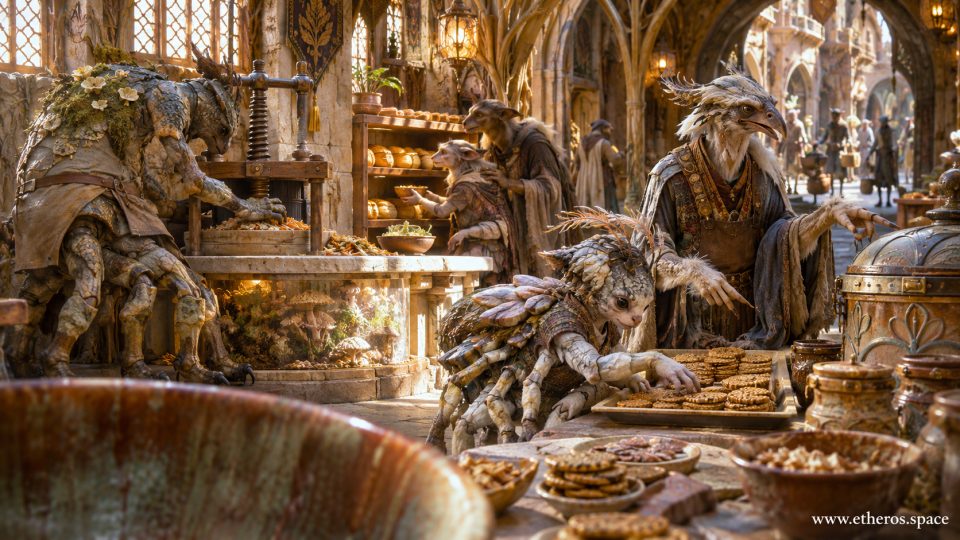
No one answered at once. The settlement had celebrated the carrier's recent cycle of renewal as a gift. The labor required to collect its discarded armor, test its strength and return it to a useful life had been called a gift as well. But the rigger's palms were split; Vask's boots had worn through at the claws. When the city received materials without paying for their collection, the celebrated generosity somehow became a private expense.
Feru set down her stylus. The new warmth-gathering root systems were spreading farther through the basin, allowing houses to use less imported furnace fuel. Their growth was a hopeful change, not a finished promise. They still needed protective housings, local repair and workers who knew where living conduits must never be cut. A free slab could not substitute for those costs.
Orlin shifted the lens so the sunlight passed through a pale fracture. 'This is what it will bear,' he said, tapping the unbroken center with one knuckle. 'Not what we wish it would bear.' He marked a narrow unsafe band with chalk. The smaller pieces might become window screens or weather shields after their edges were dulled. The central portion might be sound enough for public roofs, but only after load testing. For the moment it would remain on the sledge.
Out in the plain, the great carrier lowered its head toward a stretch of mineral scrub. A wagon passed near its enormous shadow; neither changed course to acknowledge the other. The landscape did not seem to care about the council's quarrel, yet every living thing in the basin was shaped by such decisions. Etheros nourished its inhabitants; its inhabitants were not excused from the labor of care.
They agreed to write two ledgers. One would record what the salvaged material could safely do, including the pieces that were not fit for construction. The other would record whose time had made the salvage possible, and what the city owed them before any buyer received a panel. Feru would take both to the open assembly. Kezha would not release the load until the temporary bracing passed inspection. Vask, annoyed by the delay, nevertheless tightened the coverings over the chipped pieces so no passing child could be cut.
It was a small arrangement, not a solution to every unequal house in Thren Basin. The governor could reject it. Testing might condemn most of the plate. Next season the carrier might travel to another valley and leave nothing at all. But the apprentices had seen an elder insist that a precious object remained part of a living obligation, not a prize to be seized. They had also seen a rigger ask to be paid without apologizing for the question.
By the time the sun cleared the open roof of the shelter, the wind had risen. The ropes hummed with a note too low to call music. Orlin folded his lens into its worn case. Feru held the drawing steady with both hands. Kezha eased the winch against its pawl and listened for the reassuring click.
Beyond them, the massive carrier continued toward the waiting plain. For the first time that morning, Vask looked away from the glittering slab and watched the creature itself.