What Holds the Wing
20261105T013539664531Z_066percent.png
Story
WHAT HOLDS THE WING
In Vaelor's lower arcade, a wing lay across a carpenter's bench, too beautiful for the task it had been commissioned to perform.
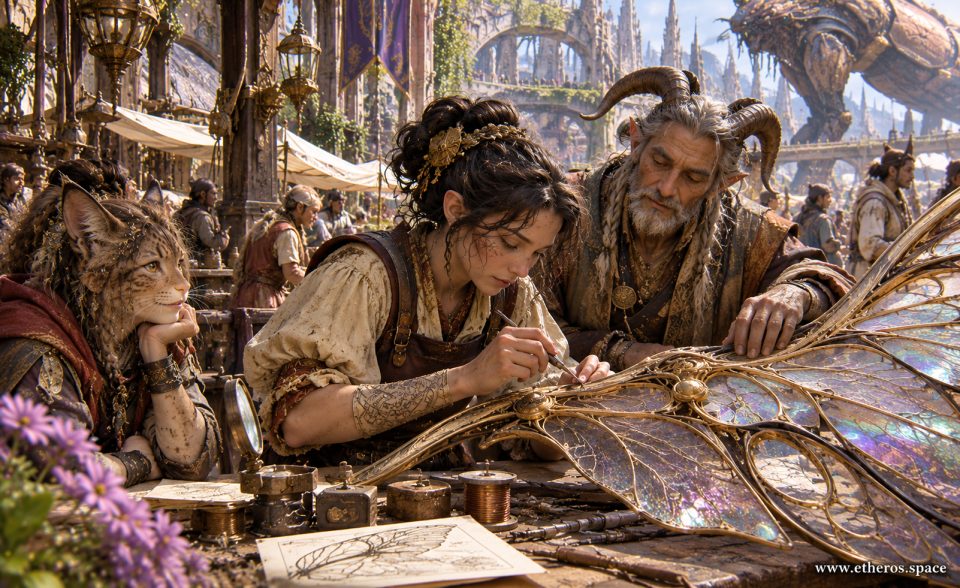
Its pale translucent panels were cradled in veins of bronze. A central ring allowed the whole assembly to pivot against a counterweight hidden in the gallery wall. Once installed above the southern passage, the single broad wing would turn slowly with the seasonal wind, shading the market in the fiercest hours and allowing sunlight back through in the cooler season. It would not fly. No living creature was being asked to trust its weight in the air.
Sera Torven had been given six days to finish the inlay.
Her last commission had been less decorative: a regulator for a public lift, withdrawn from service after its third measurement refused to agree with the first two. The repair had cost the arcade merchants time and money. She had not regretted closing the lift, but she had understood the cost well enough to accept this new work without bargaining for better terms.
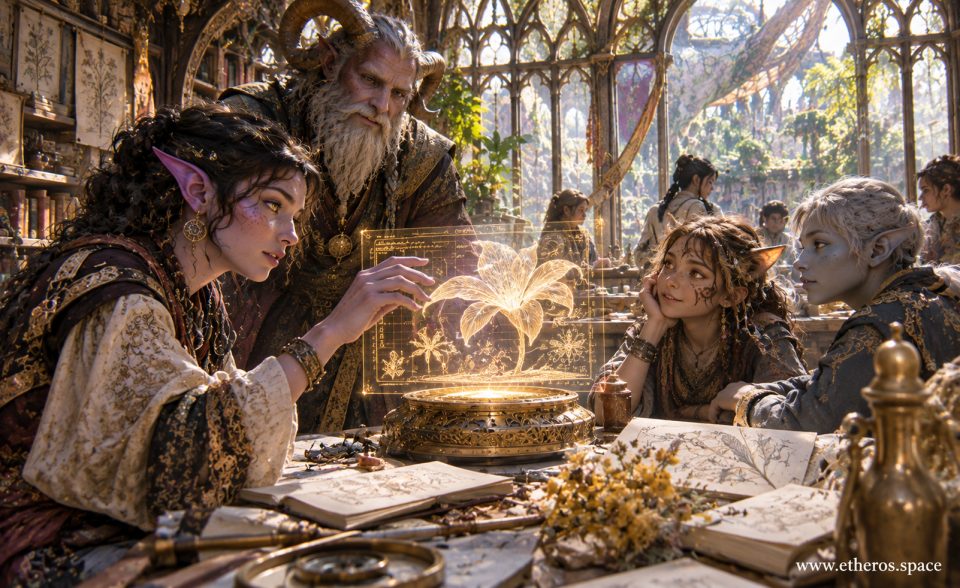
Now, beneath the awnings, she bent close to a bronze rib and drew the point of a narrow tool along its edge. A roll of wire and a sketch lay before her. Beside the bench, the horned elder Brannik held the rim steady, his broad fingers deliberately kept clear of the point. On her other side, a young spotted lynx-kin named Tikk watched with a patience uncommon in the market's busiest hour.
Tikk had never been admitted to the patternmakers' guild. No one had formally taught the child to draw a load-bearing rib. Yet three of the curves on the wing had begun as marks in the dust beside Tikk's mother's stall.
A month earlier the guild's first design had been rejected. Its panels cast a lattice of moving shadow too dense for the traders beneath, while the structural ribs trapped hot air above the passage. At the midday demonstration, Tikk had found a fallen leaf skeleton in the street and asked why the shadow could not be broken the way the leaf divided its veins.
Sera had taken the question seriously. Brannik had converted the branching idea into a manufacturable pattern, placing each curved bronze spar so that the broad translucent pieces were supported rather than merely decorated. The revision preserved the necessary weight balance while leaving openings for the upper air to escape.
By morning the wing was nearly complete. Its iridescent surfaces caught the light of the open square. Behind them, the market went on with all its private urgencies: bundles crossing the lane, merchants calling across tables, a distant service machine passing mostly beyond the rooftops.
The difficulty was no longer how to build it.
The municipal contract listed Sera as designer and Brannik as structural adviser. Tikk did not appear on the work order. When Sera asked for a correction, the clerk had explained that an unlicensed child could not hold a guild commission. The rule protected purchasers from unqualified builders, the clerk said. The clerk also admitted there was no ordinary column in the ledger for an idea contributed outside the guild.
Brannik thought the easiest answer was to give Tikk a private gift and deliver the wing on time. The market's shade had been damaged for two summers; delay would punish the stallholders rather than the clerk. Tikk's mother needed the income from her stall, and the child had been happy merely to see the new pattern made real.
Sera understood every part of that argument. A gift might help with next month's rent. It would not record what had happened.
She asked Tikk what the child wanted. The answer was neither a sum nor an honorific.
'I want someone who looks at it to know I helped.'
Brannik looked down at the shallow brass ring where the wing would meet its fixed bearing. The visible surface could not bear more ornament without interfering with the joint. But there was space on the underside of the mounting plate for a small maker's register, accessible when the wing was lowered for maintenance. The record could name the pattern's contributors without pretending that the child had certified its mechanical safety.
That afternoon Sera carried the unfinished register to the clerk. She proposed three entries: structural responsibility to Brannik, assembly and testing to herself, and branching-pattern contribution to Tikk. She also asked that the public commission pay for the time spent on revisions rather than expecting the workers to absorb the cost of everyone's improvement.
The clerk objected that revising one contract could invite many such claims. Sera agreed. Then the clerk would need a rule that could be applied to the next work, and the next, and not only to the most persistent applicant. Brannik offered to testify to the design's chronology, though he warned that not every overheard suggestion could become a claim to ownership.
They settled nothing that day. The municipality would review a short account of the contributions, and the guild would determine whether a design record could include unlicensed participants without making them responsible for structural defects. Until then the wing would remain on its bench, paid for at the ordinary daily rate. Its load test would proceed separately.
Tikk was disappointed that the answer was another meeting. Sera was disappointed too. Still, when evening fell she showed the child how to position a clean piece of translucent material between the curved supports without putting pressure on its edge.
Brannik held the rib. Tikk steadied the spare panel. Sera guided the tool.
No signature had yet been engraved. The large wing remained beautiful and unfinished, its goldwork shining while the last customers passed beneath the awnings. But it already held something the first drawing had lacked: a place for more than one kind of knowledge, and a record that might outlast the hands that made it.