The Leaf That Was Not a Prize
20261106T192334358833Z_066percent.png
Story
THE LEAF THAT WAS NOT A PRIZE
The Upper Exchange, Merrow City, in the long amber season of primordial Etheros
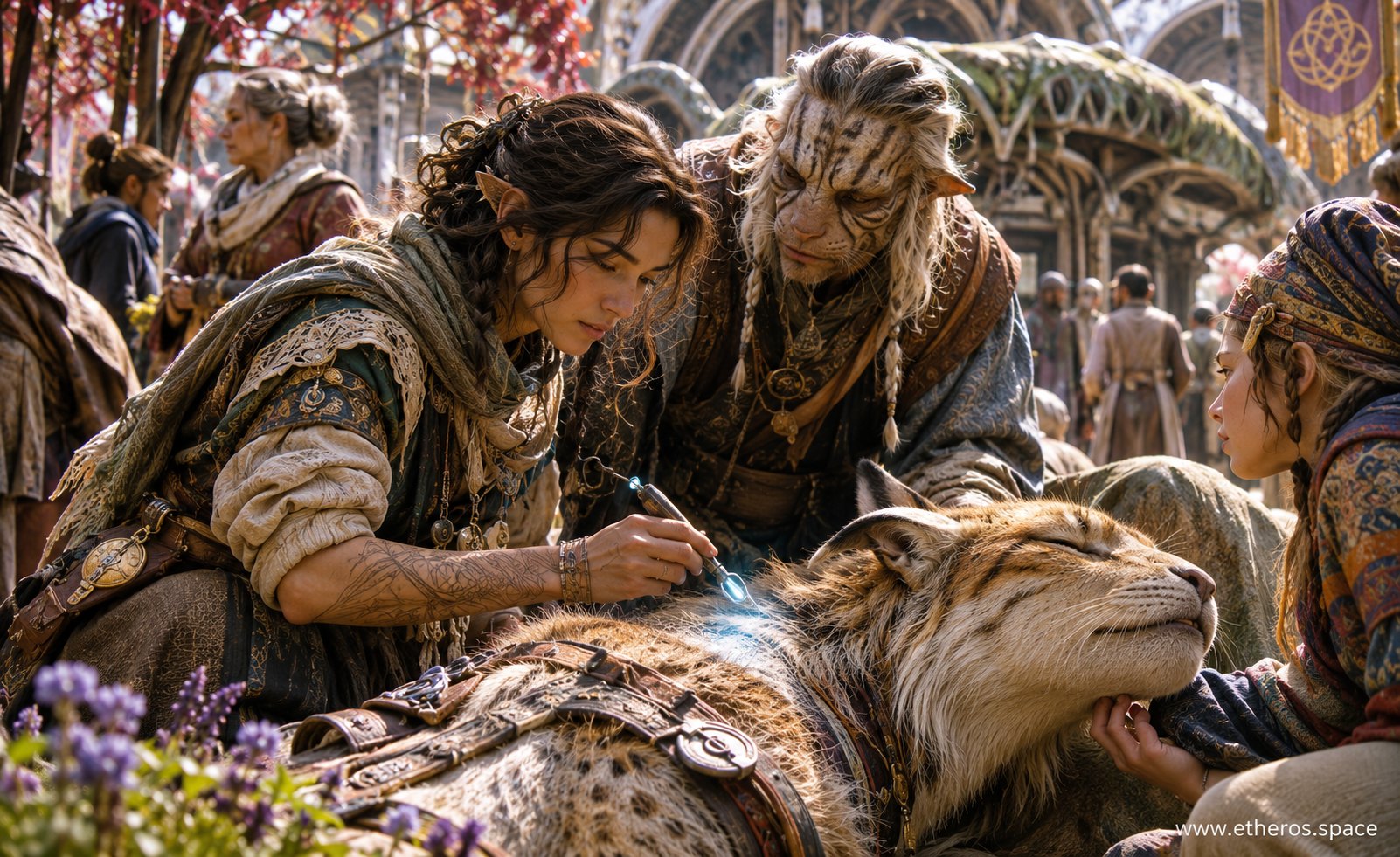
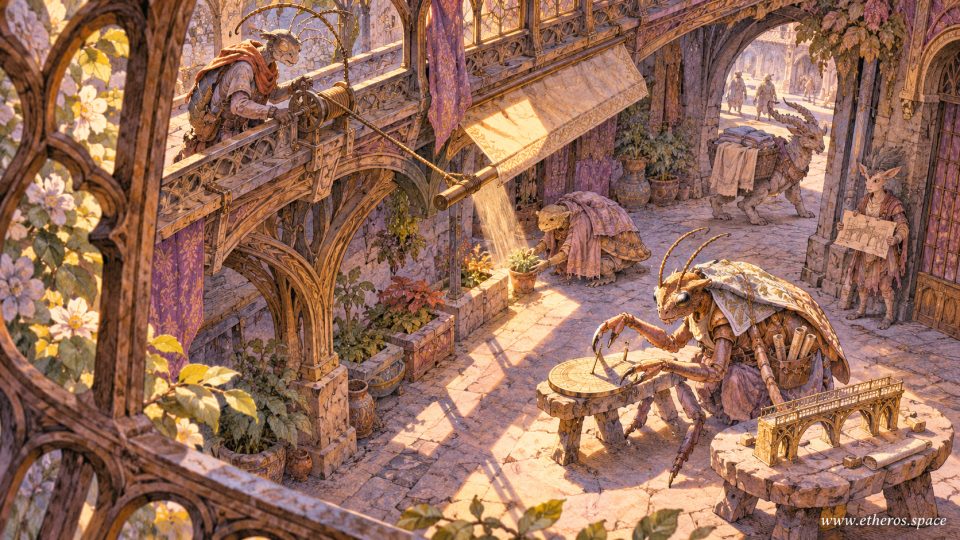
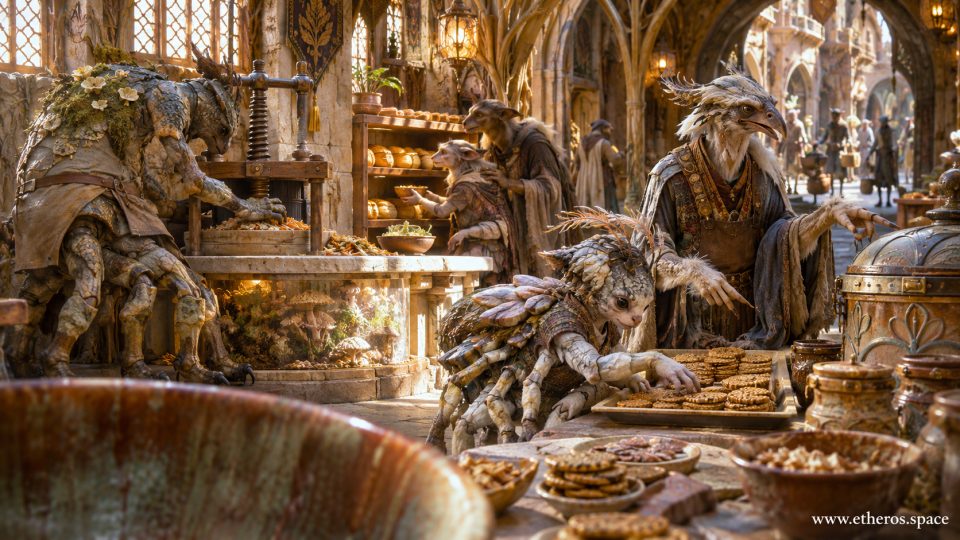
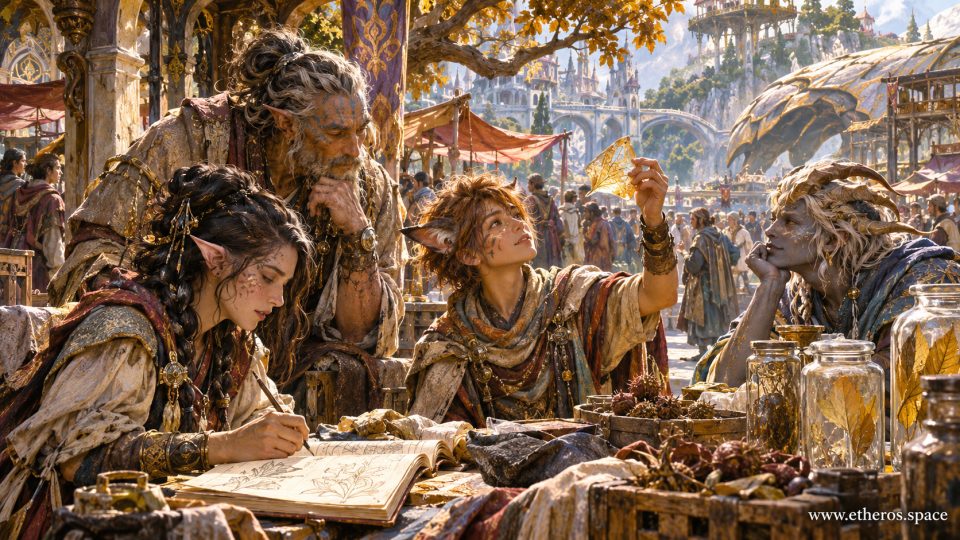
On the morning of the gathering, the Upper Exchange was loud enough to swallow anyone's name. Sellers called beneath russet awnings; travelers threaded the sunlit street among seed stalls and small brasswork counters. Beyond the bridges, the pale roof of the great civic conservatory rose like the shell of an enormous sleeping creature. There was no ceremony at the little table under the branches. A notebook lay open, and between jars of dried specimens a single translucent golden leaf caught the light.
Aven was already drawing its branching veins. She bent low, the dark braids above her pointed ears escaping their ties, and moved her pen so slowly that a passerby might have mistaken her concentration for prayer. The leaf had been brought by Tarel, a young, auburn-haired traveler who held it overhead, turning it toward the sunshine to show a fine lattice of amber pores. Close by, an older, broad-shouldered man named Dorren watched the drawing with one hand against his beard. On the opposite side of the table, the pale, horned observer Sile leaned on an elbow, patient enough not to interrupt.
None of them had found the leaf together. That was the trouble.
Tarel had carried it down from a northern terrace in the folds of a cloak, certain that it would win a place in the autumn collection. The specimen was unusually light for its size, and its branching channels retained a faint sheen after drying. At home, Tarel's family called such leaves windglass and used their discarded husks to tell whether a cold season had arrived early. The collection's buyers had another name for them: gilded breath. With that name came money. Aven's academy offered a year's wages for an intact specimen whose origin could be recorded.
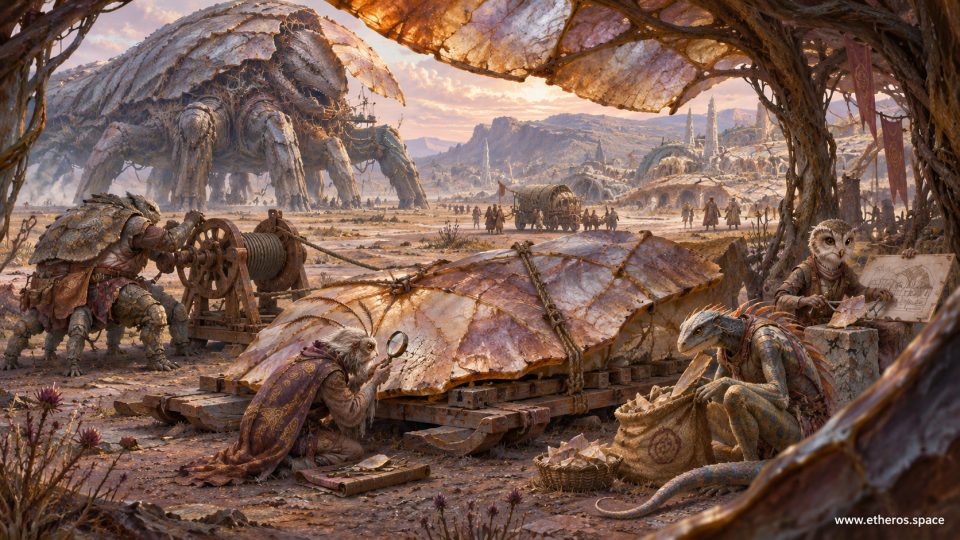
Dorren had recognized the branching pattern before the youth finished speaking. He came from a community far beyond the stone bridges, where the same kind of sheath was gathered after it naturally separated from a living canopy. His people had spent generations learning which husks could be collected without damaging new growth. The glowing object itself was not rare, he said. What was rare was the habit of waiting until it was ready to fall.
Tarel lowered the leaf a little. "I was told the first person to show it owns the discovery."
"The first to show it," Dorren replied, "may only be the first who was heard."
Aven stopped drawing. Across her page she had reproduced the elegant veins, but not the hand that had carried the specimen, nor the upland elders who knew its season. Her book would survive the afternoon; their voices might not. Sile, whose own family spoke a language scarcely used in the Exchange, asked to see the back of the leaf. It had a short, ragged seam at its base. The seam might show harmless release from a branch. It might also show a careless tear. Neither possibility could be settled by admiration alone.
Around them the market continued. A woman bargained for folded cloth. A child slipped between two laden stalls. A breeze lifted the gold-edged branches above the arch, sending flecks of shade over the ink and jars. Nobody in the passing crowd knew that four neighbors were trying to decide what sort of claim a beautiful object permitted.
Aven proposed three records instead of one. She would keep the drawing and a careful account of what could actually be observed: the pores, the branching lines, the seam, the measured weight. Tarel would record where it had been found and what the family believed about winter, noting that a remembered saying was not proof of a cause. Dorren would explain the collection practice taught in his district, while remaining free to keep parts of that teaching private. Sile would write the questions the group could not yet answer and arrange a comparison with naturally fallen husks, without buying new ones from children eager for a prize.
The academy's payment would have to be divided by agreement, not awarded to the loudest speaker. The leaf could stay with Tarel until the terms were written. Dorren did not ask them to give up the specimen; he asked them to leave the next branches living.
Tarel's disappointment did not vanish. A year of wages could repair a roof. But the older man's warning had the difficult shape of care rather than accusation. When Aven set down her pen, Tarel tipped the leaf once more so Sile could examine the golden seam. It was still beautiful. It had become something less convenient and much more interesting than a trophy.
Later, when the autumn light moved toward the far arcade, no one in the Exchange announced a great discovery. The first page of the new ledger bore four distinct names, three separate kinds of knowledge, and a blank space for what a future season might reveal. The little specimen shone between them, borrowed from a living world that none of them had made, under a canopy whose fallen gifts would outlast their arguments if they learned how to ask.