The Bloom That Held the Fever
ETHEROS_20261103T015537316326-0800_100percent.png
Story
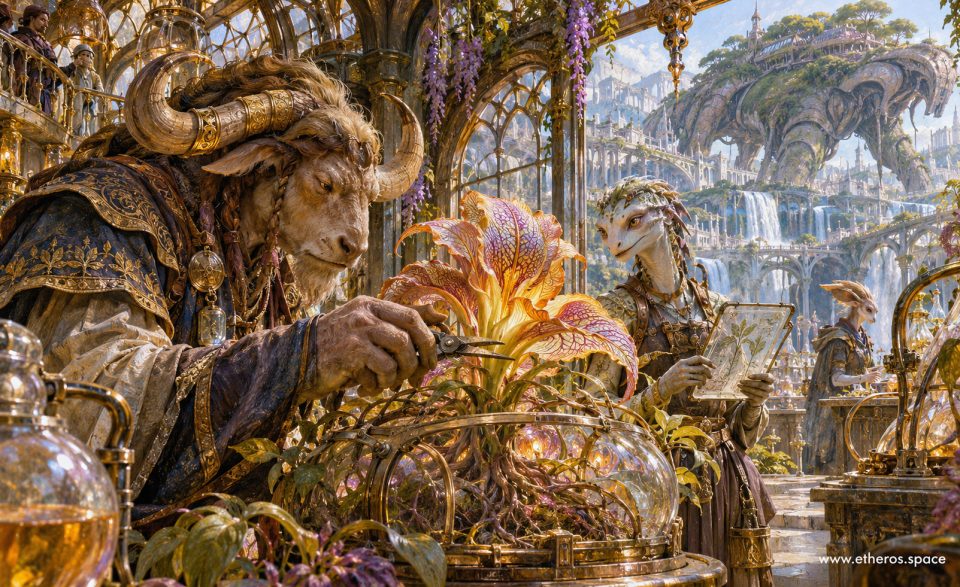
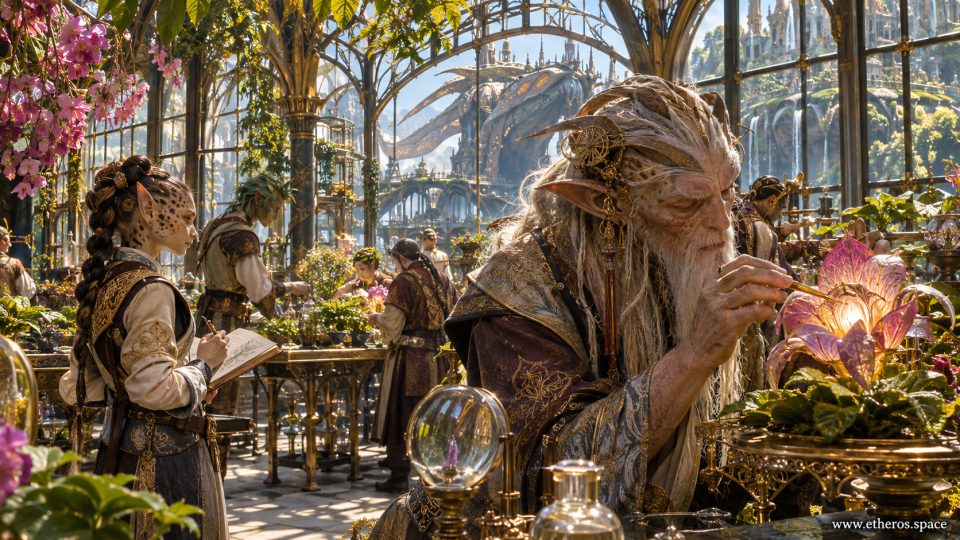
At the third clear hour, when the eastern glasshouse of Veyra caught sunlight between the canal arches, Master Ellorien raised his lens to the opening of a violet fever-bloom. Its translucent petals held a faint amber light, as though the afternoon had collected there and forgotten how to leave. He steadied one petal with a slender gilded probe. Beside him, the living root-bed trembled with the slow movement of the irrigation veins beneath its brass support.
He was old enough to remember when the glasshouse had been a roofless terrace, and when the river colonies bought their medicine from merchants who arrived only in calm weather. Now the conservatory grew its own living remedies. The cultivation tables stood on carefully jointed legs; their root lattices drew water through ceramic filters, and their braided capillaries returned depleted fluid to the recovery pool. Nothing came from nowhere, not even a miracle. The sun warmed the glass, the pumps moved the nutrient water, and the patients waited beyond the bridges.
Tavi of the spotted Auren people stood to his left, pencil poised above a thick field journal. She had come to the conservatory as a courier and stayed as an apprentice when she discovered that her sensitive ears could hear an irrigation valve begin to fail before any gauge moved. This morning she had recorded the intervals between the flower's contractions. Every nine breaths, the innermost petal folded and opened again. It was not a heartbeat, exactly, but the same quiet chemistry that caused the bloom to shine also condensed a cooling resin in the cup beneath its roots.
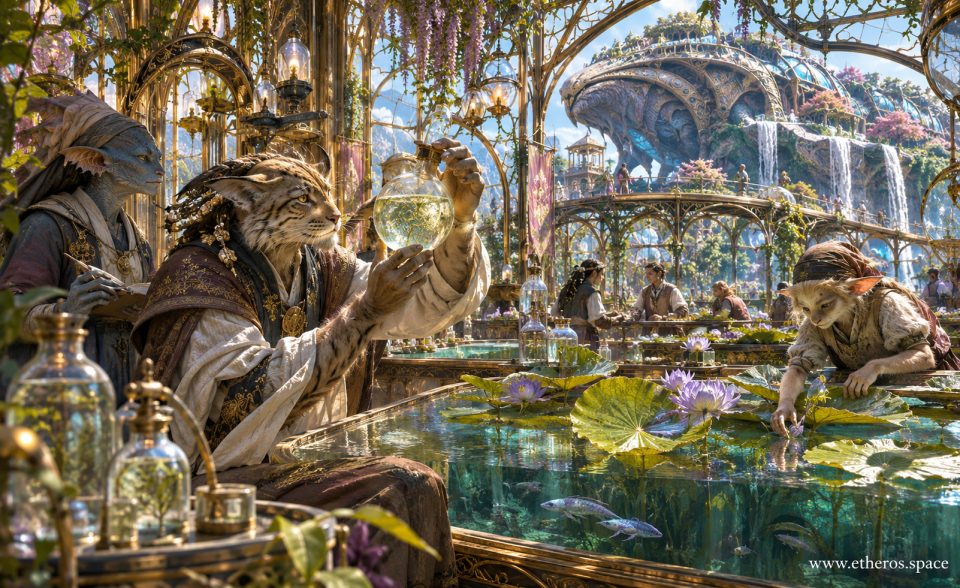
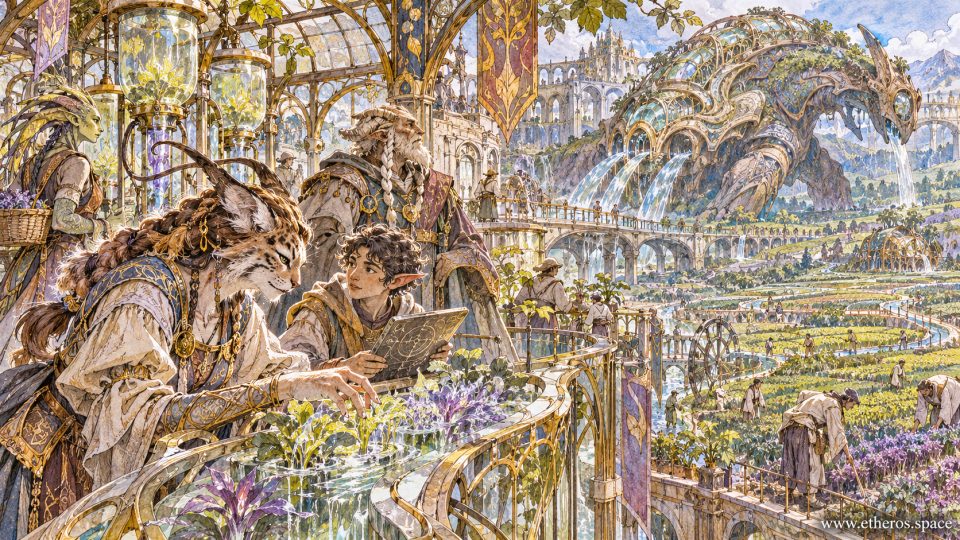
Farther along the aisle, a green-haired gardener named Senn adjusted a cluster of young plants while two other workers exchanged propagation trays. Glass vessels held clear water and cloudy filtrate in separate stations. Hanging vines shaded the more delicate species from direct light. Beyond the tall windows, the city's arches stepped toward a bright gorge. Something vast and biomechanical moved among the distant bridges: a municipal lifter whose broad armored surfaces caught the sun. Its task was to raise feedwater and cultivate the elevated terraces; here inside, the gardeners depended on the slow pulse of that distant labor.
The flower had bloomed early. In another year Ellorien would have let it finish its cycle, collecting resin only when the petals naturally closed. But a humid fever had reached the lower nursery wards, where the youngest patients could not tolerate the usual mineral salts. The bloom offered a gentler remedy. Every measure mattered. Harvest too soon and the resin would be thin, harvest too much and the parent plant could lose the strength to flower again.
Tavi checked her page. "The brightness is falling between the seventh and eighth fold," she said.
Ellorien did not answer immediately. The bloom was still luminous, and he understood why the junior growers wanted to cut it. He also saw a narrow dry mark running along the outermost petal, the kind that appeared when a root-bed was receiving water that had not been warmed enough. He lifted the probe and pressed two fingers to the brass rim. Cold. The capillary pump was delivering flow, but a heat exchanger in the far line must have slipped open during the morning flushing.
He asked Senn to turn the recovery valve half a mark, no further. The gardener walked the length of the bench and did so, then held one hand against the pipe until its vibration settled. Warm reclaimed water returned under the leaves. Ellorien watched the dry streak slowly soften. They waited through another cycle, all three of them listening: the rustle of the greenhouse, the distant workers, the faint rhythmic click of a service gear as it released its load.
Only then did Ellorien touch the collection vessel beneath the flower. Three amber drops gathered at the lip. He drew them into a narrow glass ampoule, sealed it, and set the ampoule into Tavi's carrying case. The amount would not heal a city. It would help three children through one dangerous night. By morning, if the parent bloom remained strong, there might be three drops more.
Tavi wrote that down with the same care she had used for the petals. The conservatory taught a strange arithmetic: abundance was not the largest harvest one could take, but the largest harvest the living system could keep giving. Outside, the great lifter continued its patient work; inside, the little medicine waited in its glass capsule, scarcely heavier than rain.
Before the apprentice left for the nursery, she looked once more at the gold-edged flower and the elder whose hand had hovered over it so long. She would remember the light, certainly. But years later, when she became keeper of the glasshouse herself, she would remember more clearly the interval in which nobody touched anything, and all of them allowed the plant enough time to answer.