The Wind Before the Leap — Dawn at Orelith Rookery
ETHEROS_20261105T021529461804Z_033percent.png
Story
THE WIND BEFORE THE LEAP — DAWN AT ORELITH ROOKERY
At Orelith the first lesson of flight was always given on the ground. The ridge elders said this was because stone remembered every carelessness, while wind remembered nothing. Children generally found the saying boring until they were old enough to stand with their toes at the edge of the grass and see the pale roofs of the lower city suspended beyond a thousand fathoms of air.
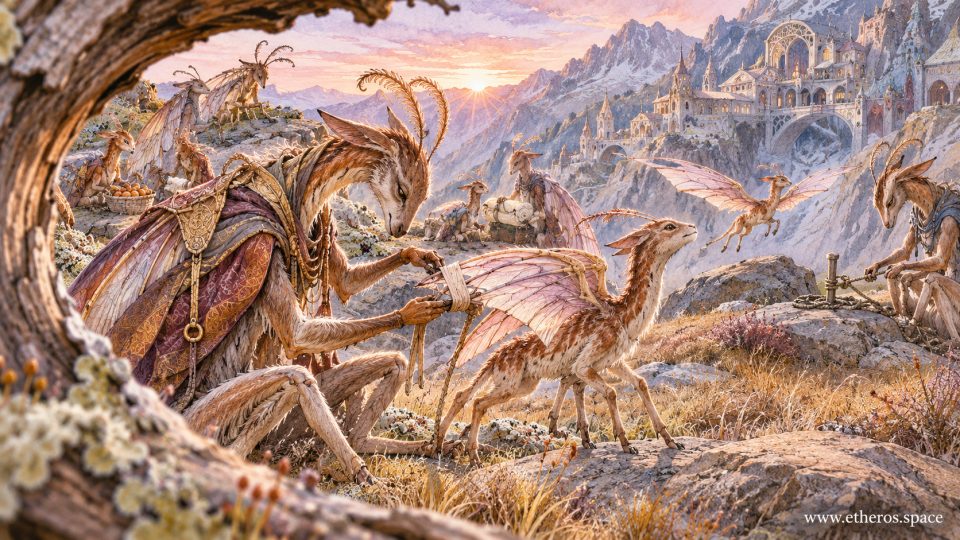
On this particular dawn a tree older than the nearest bridge sheltered the practice shelf. Its bark framed the rising sun, and white lichen glowed along the rim of the rock. Behind the little aerie, the mountain-city stepped up the cliff in arches and spires, already awake. The hanging walks had been built by generations who understood what a wing could do, and what it could not.
Jorra knelt beside Miri, turning the younger flyer's right membrane toward the light. Jorra was a broad-antlered, tawny-furred elder whose ceremonial shoulder plates had long ago been repurposed as pockets for rolls of binding silk. Their hands worked carefully at the point where translucent skin met the narrow, springing ribs. The pale strip of cloth was not decoration. It spread the pull of the next short glide along three supports instead of concentrating it on a single tender joint.
Miri held still with the fierce concentration of someone who had vowed not to show fear. The little one's legs were planted on the uneven rock, muzzle tilted toward the open valley. A slight breeze stirred the long ears and pinkish membrane. No one called Miri brave. At Orelith that word was saved until after a safe landing.
A season ago, the aerie had issued fine imported harnesses to the cliff couriers and left the younger families to mend their own. The decision had seemed sensible in the meeting hall. Couriers carried medicines and urgent messages. Children, it was said, could always wait. But children did not stop growing while they waited, and it had become increasingly expensive to learn the skills that would one day keep the entire settlement connected to the neighboring ridges.
Now the communal shelf was crowded. Higher among the rocks, antlered parents and young fliers crouched beside woven baskets and rolled bedding. One youngster stood with wings unfolded as another watched the wind's tiny movements in the alpine grass. A little farther out, a daring flyer was already airborne, with forelegs tucked and wing membranes held in a shallow, measured curve. At the right-hand edge Tesren kept one hand near the practice tether's anchor, not to pull a child through the sky but to prevent a sudden slip from becoming a fall. The cord carried a modest catch load; the creature's own wings and the morning updraft carried the rest.
'Not tighter,' Jorra said when Miri stretched the new binding. 'Wider. The gust doesn't ask which rib is yours.'
Miri inspected the cloth and asked whether the courier guild would object to using the same silk reserved for licensed flights. Jorra tucked the free end beneath the last fastening. 'They might. Then we will ask them to look at the young who have been waiting.'
From the far edge came the sound of delighted hooves on stone. Hesh, a smaller flyer, had returned from a very brief crossing of the thermal line and was circling for the marked patch of safe ground. The watchful adults did not cheer yet. They counted breaths; they watched the fold of a wing and the angle of the descent. Only when the small hooves settled did a ripple of laughter travel back along the shelf.
Jorra remembered another season when that laughter had been missing. A run of harsh, hot dawn winds had driven many families down to lower ledges. The city supplied warning bells, but the bells were placed near its busiest trade bridges. On the outlying aeries, parents made judgments by the movement of pollen and the tremor of grass. Since then Jorra had persuaded neighbors to share wind readings, spare bindings and a place where no child would be turned away for an unpaid guild fee.
It was hardly a revolution. It was a blanket spread over a stone, a basket of fruit passed between households, a patched membrane and the time of an elder who could have been resting. Yet when the first golden light touched the distant city arches, the gathering had made something more durable than a flight lesson: a way for the strong and the uncertain to belong to the same morning.
Jorra eased the last knot, laid one hand against Miri's shoulder, and waited for the younger flyer to decide when to move. There would be no dramatic leap for the crowd. First a few steps, then a short slide along the sloping shelf, then the soft rise of warm air. Miri would learn the familiar law of the ridge—that the wind could lift a body, but only the living community below could make the attempt merciful.
For now Miri remained standing on the rock, feeling the new binding settle. Across the sunlit gap the little airborne figure was only a fleck of rose against stone. Jorra watched the membrane rather than the horizon. This, the elder knew, was how a future began: not with the person already flying, but with the hands that made it possible to try.