The Roots We Could Still Carry
20261105T015556600232Z_100percent.png
Story
THE ROOTS WE COULD STILL CARRY
At the seventh terrace of Vethril the ground was the color of old copper, and everybody knew the sound of a dry root snapping. It was brief, like a finger tapped against glass. The people who made their living there listened for it more closely than they listened for the distant bells from the ridge.
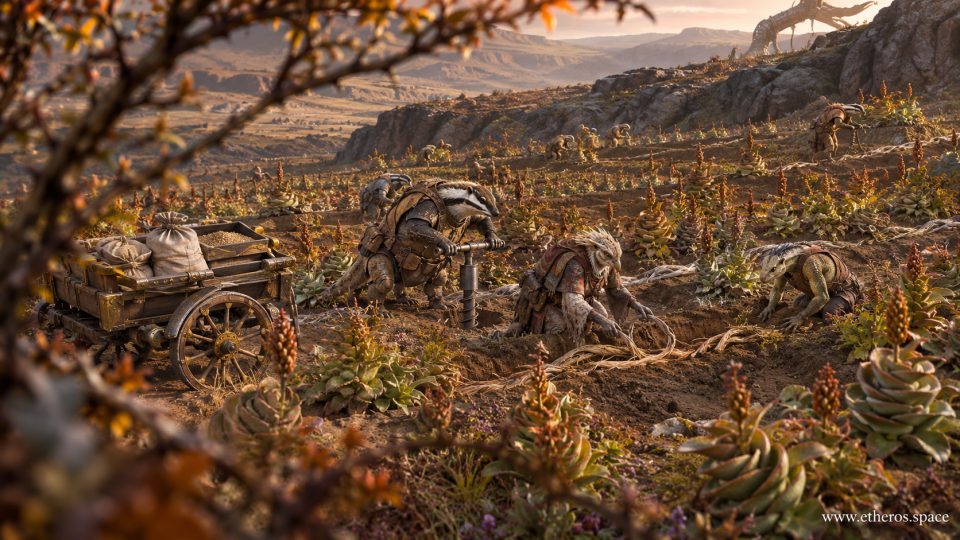
In the last amber hour of the day, three workers had stopped a handcart among the spiral-leaved food plants. Its wooden wheels rested against stones; the sacks were tied down and a shallow tray of granular inoculant lay open behind them. The crop itself still grew, its rust-colored flower spikes upright, but the roots beneath the nearest beds had begun to separate from the living mesh that carried nutrients between terraces. If that mesh failed, the upper field would wither long before the rains returned.
Dorr, a broad, badger-faced groundworker encased in patched plates, planted the nose of an auger in the hard earth. He held its crossbar level with both hands and turned it slowly. He could have forced it faster. Instead he listened to the pressure change beneath his feet. Several rows farther upslope, other laborers worked in silence, bent into the ocher plants, and the sound of Dorr's drill seemed very small against the open hills.
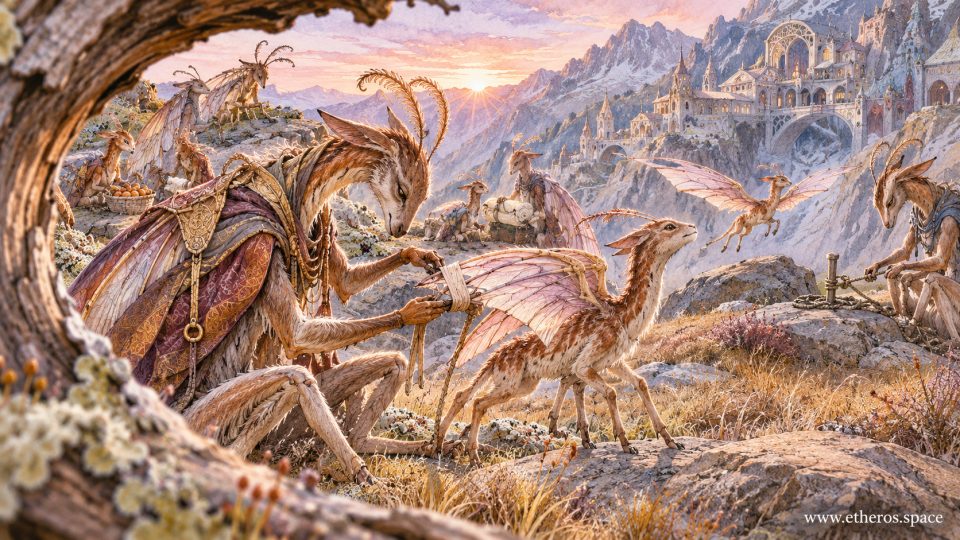
Beside him, old Vaesi was crouched in the newly opened furrow. Her pale feather crest was marked by the dust of a hundred seasons. She drew strands from a thick, cream-colored bundle of root cable, not cutting them but freeing each branching tip so it could make contact with the exposed network. In other years a guild wagon would have delivered neatly prepared living thread, wrapped and ready to graft. This year the price had climbed past the terraces' common purse, and the wagon had come only as far as the first district.
Across the trench, the younger, green-scaled Orin pressed loose soil against the root ends, tamping it with the flat of a hand. Orin had been trained to value speed: a full bed before sunset, a full field before the counting bell. Vaesi kept lifting her hand until the soil was snug but not hard.
'It has to breathe,' she said. 'A covered root isn't the same as a joined one.'
Dorr stopped turning. In the damp shadow just under the surface—not a drop of water in sight, only the coolness the stone held—the new strands had found one of the old pale fibers. Vaesi waited. There was no sudden light, no miracle of growth. A tremor crossed the thin cord; the neighboring leaves scarcely moved. She nodded once, and Orin packed the edges more gently.
The trouble had not begun in Vethril. Distant kilns that made mineral meals for the soil had reduced their fires. A guild of carriers had raised its price as the uphill routes became harder to maintain. Some farmers argued that the terraces should buy fewer roots and plant only the plots that yielded the most in a season. Others wanted every household granted its old share even if all the beds produced less. Neither argument was foolish. The storehouse could not divide what did not exist.
Three nights earlier the district council had proposed closing the least profitable outer rows. Vaesi, whose own family lived above those rows, had brought an old field ledger to the meeting. Its figures did not promise an abundance of food. They showed something less comfortable: a root bridge severed at one terrace eventually weakened three adjoining beds, regardless of whose name appeared on the deed. To abandon one family's strip was not necessarily to save the others.
Now the workers were testing the cheapest remedy they could carry. The shallow cart held two sacks of starter grain, enough for an experiment but not a whole district. Dorr's auger made openings for the living strands. Vaesi chose which pale fibers were healthy enough to join. Orin closed the earth around each graft and marked the places where the bed would need watching. Their hands were different, and their work depended on those differences.
A ribbed silhouette rose on the far upper escarpment. From this distance it might have been an old structural conduit, or part of one of the planet's enormous working bodies. None of the three could tell. No giant machine descended to solve their problem; the little cart and the branching roots remained their available means.
When the light began to flatten over the mesas, Orin looked back at the many terraces still waiting. 'If this takes, who gets the next sacks?'
Vaesi held out a pale strand across the trench. 'First we find out whether it takes.'
'And after?'
Dorr drew the auger from the soil and leaned on it. He had lost an entire planting season once, years before, by agreeing too quickly with a confident forecast. 'Then we invite the people from the outer rows to watch us count,' he said. 'If their ground is part of the same root, they should see the measure.'
Orin tied a little ring of cord around the repaired stem to mark the bed for inspection after two nights. The gesture did not settle who would pay the carriers, or which kiln would relight, or whether the next dry season would be kind. Yet it made an obligation visible. Somewhere below the terrace, roots that had not chosen the borders above them lay side by side beneath the copper earth.
Before leaving, Vaesi rested her hand on the furrow and counted the faint living pulses: one, then another, then a silence too long to trust. She wrote down the silence as carefully as the pulses. This, she believed, was where stewardship began—not with the promise that a world would always provide, but with the willingness to discover precisely where its care had become insufficient, and whose hands were needed to mend it.