The Hour Nobody Owned — Lantern Court at Rookspine
ETHEROS_20261105T001641660139Z_033percent.png
Story
THE HOUR NOBODY OWNED — LANTERN COURT AT ROOKSPINE
In Rookspine, the workers called the hour after the last shift the hour nobody owned. The quarry masters did not pay for it. The ferrymen could not charge passage for it, because there was no river. Even the night watch allowed its bells to drift a little late when the children were playing.
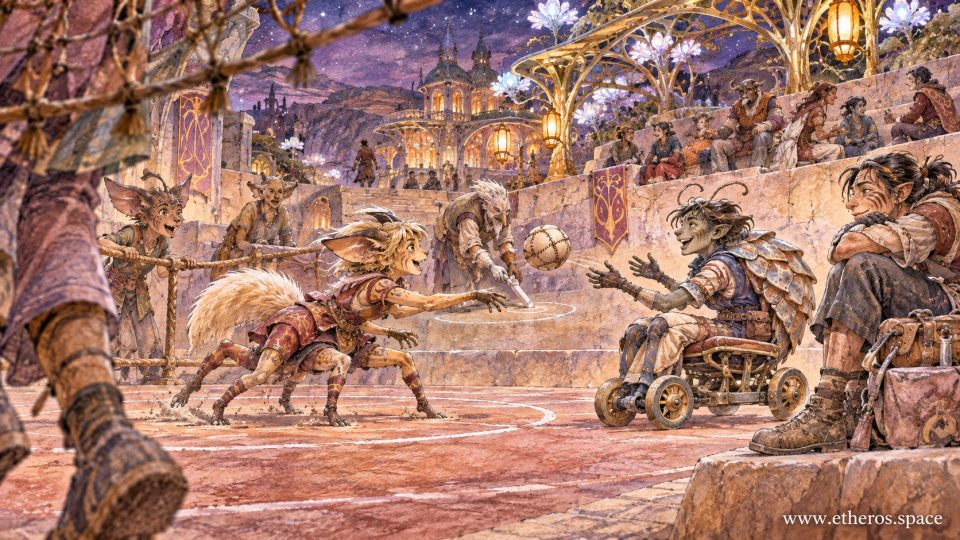
On the oldest terrace, beneath a trellis of silver-flowering vines, a ball hung for a moment in the lanternlight.
Sella had sent it spinning from her foremost hand. All six of her limbs were still engaged in the movement: four clawed feet finding purchase on the chalk-marked stone, one arm extended after the pass, the other held low for balance. Her great tawny tail swept dust from the court. An instant earlier she had looked ready to stumble. Now she was laughing.
Across the painted circle, Tovan raised both hands from his narrow wheeled chair. The bronze spokes flashed. His shell-like back plates were strapped clear of the wheel rims, and the little wooden footrest that his father had adjusted that morning remained firmly in place. The ball would reach him if he leaned another finger's breadth forward. He did not ask for anyone to slow it down.
The rest of the players had already learned that asking Tovan to be careful was the quickest way to make him furious.
A white-feathered official, old Vesh, had stopped his chalk beside the center line to watch the flight. He was meant to be ruling on whether Sella's last foot had crossed the mark. Two spectators in the upper gallery were shouting incompatible judgments. On the steps, a tired stonecutter with his boots still powdered gray rested his elbows on his knees and smiled into his palms. Beyond him, neighbors from three terraces sat beneath hanging copper lanterns, their voices crossing and recrossing like the rootwork beneath the city's foundations.
The game was called three-ring passage, though no two neighborhoods agreed on exactly where the third ring should be painted. In Rookspine it was the narrow outer crescent. Anyone who caught a pass there earned the next play for the opposing team. The rule had been introduced long ago to keep faster runners from hoarding the ball. Nobody remembered who first proposed it; everyone argued about its application.
Tonight was the first match played since the stonecutters' council had changed the evening shift.
The new bell schedule allowed furnace tenders and lifting crews to finish together, which meant fewer exhausted workers left alone at the end of a difficult day. But it also meant the junior apprentices arrived home after the lantern court's usual closing hour. The city watch called that a sensible compromise. The children called it theft.
Sella's mother had worked the second lift since dawn. Tovan's father made wheel bearings in a shop under the western stairs. Neither family could afford to abandon the new shift, and neither wanted a dispute with the council. So on the first clear evening, the families brought the problem to the court rather than the council house. They gathered everyone who actually used the place: learners and laborers, balcony dwellers, elderly watchers, street vendors and the keepers responsible for the lamps.
The lamps required fuel. The grounds needed sweeping. The fragile garden trellis could not carry another night of careless climbing. Someone would have to pay for longer hours, and someone would have to go home at the same time to light the common stairways. The answer could not simply be to declare play free of cost.
Vesh, who had kept score for nearly forty seasons, proposed that the court stay open one extra bell on alternating evenings. The potters offered to donate two lamp reservoirs. The quarry apprentices offered to maintain the chalk markings and repair the stair rail. Tovan's father promised to inspect the carriage wheels used by the younger players, on the condition that no one treated his son's chair as a public experiment.
That condition earned him a sharp look from Tovan, who believed himself entirely capable of deciding what might be repaired.
They had not finished discussing how to share the work when Sella's ball sailed out of reach and struck the edge of a worn stone step. The ball bounced high, straight toward Tovan. He caught it with both palms and drew it down to his chest. For a breath he was still; then he spun one wheel and sent it backward through the open side of the ring.
The crowd burst into conflicting cries. Sella fell into a laughing crouch. Vesh finally looked down and found the chalk exactly where it had been before the pass.
“Did she cross?” demanded an apprentice from the back gallery.
“She had not yet crossed,” said Vesh.
“But you were not watching her feet.”
“I was watching the ball,” admitted Vesh, to a chorus of delighted jeers. He lifted the chalk. “That is what happens when a person is asked to keep score and settle a town's business in the same hour.”
The point was replayed. Nobody objected much. Half the children were already calling for another game.
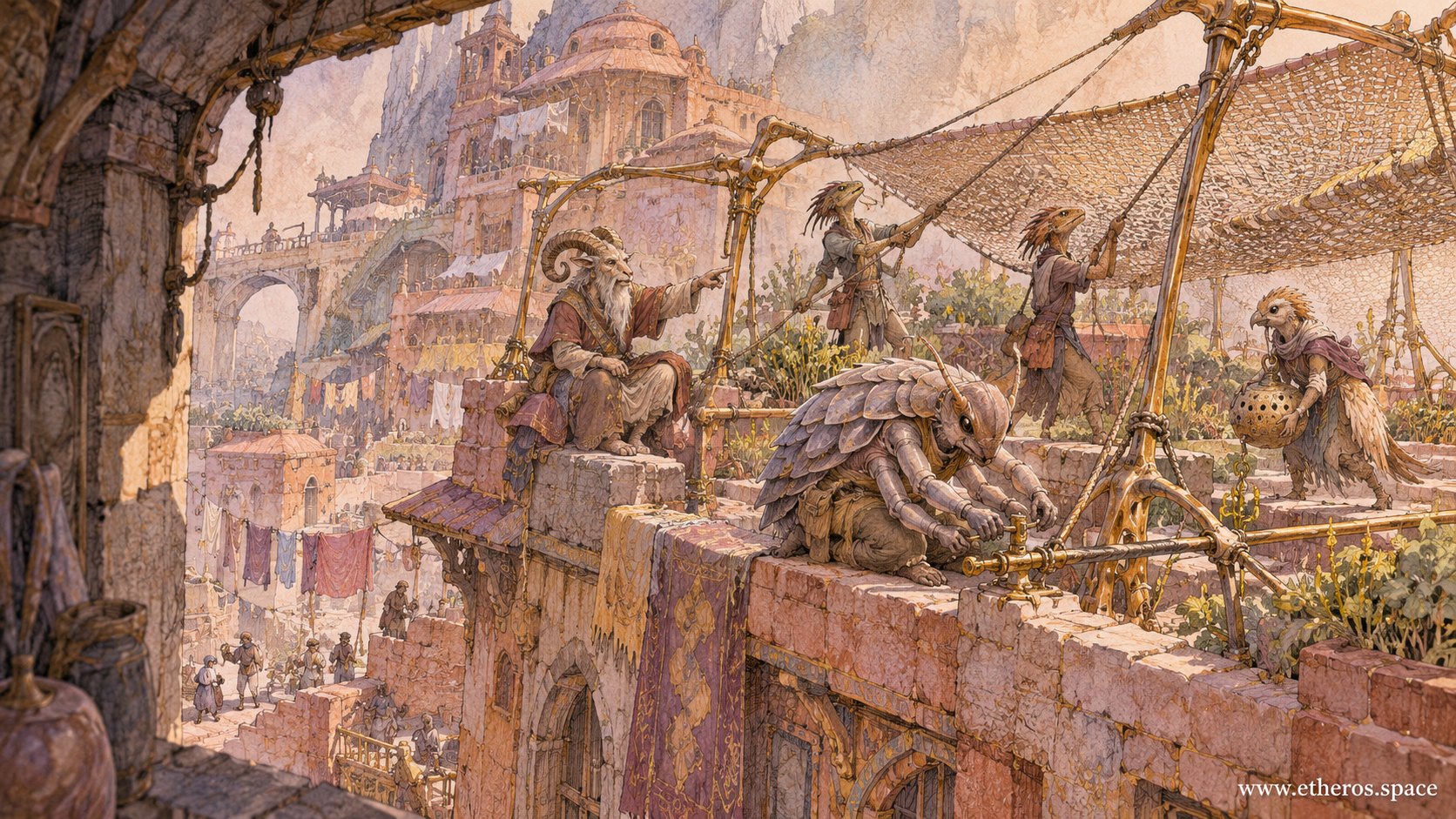
Above the court, ancient Gothic arches held the smaller living ribs that fed the lantern vines. Their pale blossoms opened wider as the air cooled. Farther up the terraces, windows appeared one by one in the dark houses of Rookspine. The city had been built by people who imagined that strength meant keeping the weight of the world above them from falling. Its surviving beams offered a different lesson: weight was shared across many contacts, and the contacts were worth tending.
When the game ended, the players wiped the chalk from their hands and helped gather the loose ropes. The lantern keepers counted what fuel remained. The council would still have to approve the new hours. The employers would still have to explain why the revised shift had been arranged without the younger workers in the room. There was no promise that everyone would receive what they wanted.
Yet Sella and Tovan had played until the stars appeared, and, for one night, the people responsible for closing the court were the people who had used it.
As he rolled toward the gate, Tovan called back to Vesh, “Next time, watch the feet.”
Vesh raised his chalk in salute.
“Next time,” he said, “bring a second referee.”