Four Knots at the Quiet Fault
20261105T042811936049Z_067percent.png
Story
FOUR KNOTS AT THE QUIET FAULT
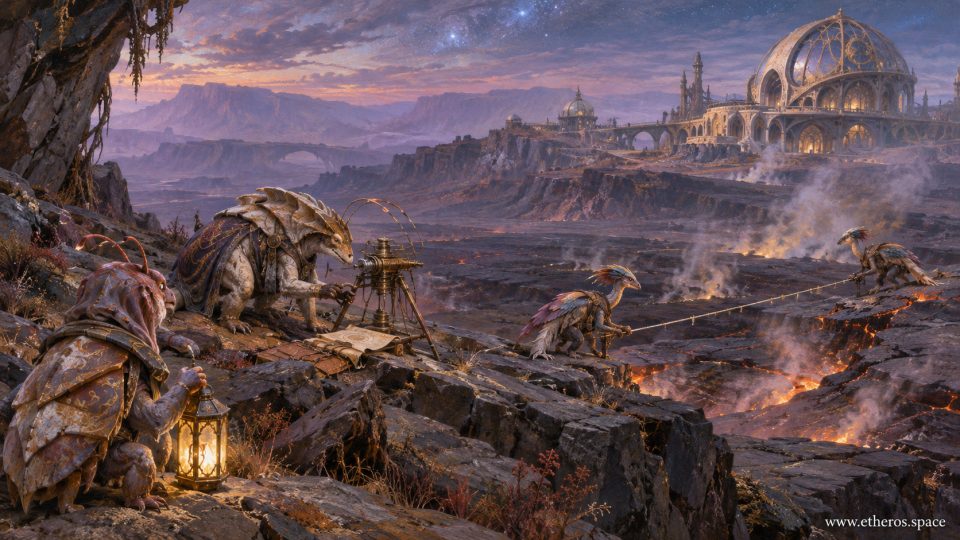
From the lantern ledge above Cinderglass Basin, the city of Vellune looked too beautiful to have any troubles of its own. Its observatory dome caught the last violet of sunset; its narrow arches carried evening foot traffic across the ravines. Even the low smoke from the basin seemed harmless from that distance, a white thread caught in dark stone.
Pell knew better than to trust a distant view. With one claw around the handle of a square lantern, the young shellback crouched behind a warm rock and watched a pale plume rise from a crack that had not smoked during the previous watch. Pell's wide ears folded back whenever the fissure hissed. It was not fear alone. His family kept a night stall beyond the bridge, and the shortest path to it crossed the very rock they were measuring.
Orun, the senior listener, stood over a three-legged brass instrument beside a sheet of maps. His thick plates and embroidered work mantle made him look like a creature designed for mountain cold, but his knuckles trembled as he tightened the final screw. He had once mistaken the ordinary contraction of cooling stone for a serious subsurface movement. The council had closed the southern ledge for nine days, and the porters who lost their fares had never entirely forgiven him.
"A warm seam is not an eruption," he said, more to himself than to Pell.
At the opposite side of the fissure, the feather-crested surveyor Sivet lowered a hooked foot against solid basalt and pulled a cord across the gap. Marru, farther to the east, answered by drawing it taut through a brass eye fixed to a separate stone anchor. Between them the line carried four little knots at measured intervals. Their spacing would tell them whether the broken plates were drifting apart. The cord could not predict the future, Orun reminded them. It could only record how the rock behaved while they watched.
The first reading was ordinary. The second was not. By the third, one knot had moved the width of a fingernail relative to its mark. Sivet glanced toward Vellune, where the lamps were being lit beneath the great observatory arches. A cautious closure would send the evening carriers around the higher ridge; a hasty order could cost people their work and leave the infirm without prompt deliveries. Keeping the path open could be worse if a traveler stumbled through a fresh split in the dark.
"What do we tell them?" asked Marru. His plumes stirred in the air rising from below. "That the mountain has decided to wake?"
"We tell them what we measured," Orun replied. "Not what we imagine it means. The warmth rose. A seam widened a little. We don't know whether both changes come from one cause."
Pell made a quiet sound under his shell. His mother had taken that crossing for forty-two seasons. To forbid it without asking the people who used it seemed cruel. To say nothing because they might object seemed crueler. He brought the lantern to the edge, held it low, and discovered a second narrow split along the place where workers habitually stepped over the black rocks. It was almost invisible in dusk's purple light. He set the lantern beside it and called the others over.
Orun looked for a long time. Then he added a new mark to the map. There was no celebration for being right about a dangerous thing. Sivet reset the four knots and recorded the temperature against the faint pulse of Orun's instrument. Marru did not release the line until their shared readings agreed. In the bowl of the basin, the white plumes went on rising without any concern for the names people gave them.
Before full dark they sent a runner to the observatory, not with a proclamation of disaster, but with two requests: close the short crossing until morning inspection, and light the longer ridge path at the city's expense. The porters were to receive vouchers for the extra distance. Pell insisted that the warning be posted where workers started their journeys, not only in the council's upper hall. Orun accepted the correction without defending his rank.
There was one more thing to record: Pell's lantern by the second split. It was not a grand scientific discovery; it was the practical knowledge of someone who walked a road every day. Orun asked Pell to mark the finding in his own script on the margin of the map. His name would remain there beside the readings. When the city decided what came next, the people who knew its paths would have evidence of their own.
The great dome of Vellune glowed steadily across the gorge. No emergency bells sounded. No one declared the ancient mountain benign, or doomed, or finally understood. Four figures packed up their instruments as the plateau deepened into night, leaving the cord's anchors fixed for a new measurement at dawn. For that one evening, the work of protecting a living city had been neither prophecy nor heroism. It had been a question asked carefully, answered provisionally, and shared before the darkness made it harder to see.