What the Warp Could Bear
20261105T012359387019Z_066percent.png
Story
WHAT THE WARP COULD BEAR
Night Shift at the Kharvell Lower Looms
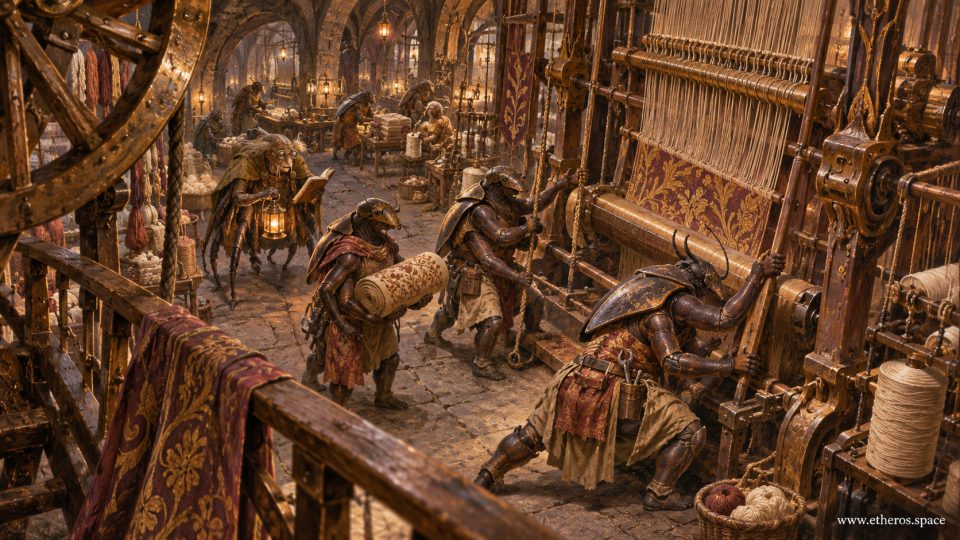
By the last lamp change, the Lower Looms smelled of warmed spindle grease, dried dye, old cloth, and stone. The ceiling of Kharvell's weaving cavern disappeared into a sequence of ribbed arches. There was no daylight left to measure by. Brass lanterns hung between the machines, and each lantern carried a small circle of visibility into the larger room.
The loom at the eastern wall had been making a length of crimson fabric, worked with delicate gold stems and tiny flowering shapes. Above it, a field of pale warp threads stood in taut parallel lines; below it, the heavier cloth gathered slowly against a thick wooden roller. On an upper walkway, someone had left a richly patterned shawl over the railing, its edge hanging into the foreground like a curtain that had forgotten its stage.
Khoren Ith, a beetle-kin loom fitter with a broad, dark carapace, kept one jointed hand on the heavy lever while another tested the guide frame. His feet were braced wide on the stone floor. At the lower end of the mechanism, Nakhin held the smaller bar steady, listening to the irregular knock coming from the winding assembly.
Across the aisle, Lorr, who carried finished cloth for packing, paused with a rolled bolt against his chest. Work usually flowed around him without interruption. Tonight he waited, because the great frame was moving unevenly and nobody trusted it to pull another full length.
The trouble was not dramatic enough to attract a crowd. No spindle had burst; no one had fallen. The loom merely asked its workers to hold a strain that the machine's own fittings should have carried. Left unfixed, that small failure would become the sort of accident everyone claimed afterward to have foreseen.
Farther back, the elder registrar Savael approached with a lantern in one hand and an open book in the other. Pale hair escaped around his spectacles. The ledger's pages showed costs for wool, living silk, dye powder, lantern oil, and transport. The columns for wages were narrower.
Khoren asked for the mechanism to be stopped.
"We are short by eight lengths," said Savael, not as an accusation but because the order was real. "The guild will want to know why they are waiting."
"Then write why," Khoren answered. "Do not write that the workers were slow."
The finished roll in Lorr's arms had already been promised to a hall in the uplands. Other fabric was intended for household shutters, children's winter tunics, and the high court at Rookspine where the evening games were becoming popular. The mill had obligations beyond its own walls. Delayed delivery would mean delayed payment; delayed payment would reach households before it reached the guild.
Nakhin slid a small wooden wedge under the metal guide and withdrew a hand. The knocking stopped. Nothing about the silence meant the loom was safe to run. A wedge could hold a fault still without curing it.
"There is a second account," Lorr said.
Savael looked up.
Lorr shifted the cloth roll to his other arm. He counted out the time spent untangling fibers before the first bell, removing burrs from the reed teeth, helping new workers fit harnesses to their differently shaped bodies, and carrying spoiled lengths back to the dye room. Those tasks kept the workshop open. They appeared nowhere in the narrow wage columns.
For a moment the old registrar studied the written figures as though he had never seen his own handwriting.
Savael had kept the mill through two lean seasons. He knew what an empty cash box could do. The owners had promised higher pay after the next large order; each month a new cost intervened. He could not make money by speaking kindly, and the workers could not feed their families on promises.
Khoren said nothing more. He was still bracing the lever, his shoulders turned toward the loom rather than toward Savael. His duty was to prevent the heavy roller from taking up an uneven load while the fitting was examined. His opinion of the account could wait until both hands were free.
Savael finally placed the lantern beside the bench. In the ledger's margin he drew a second ruled line. He asked Lorr to name the unseen tasks, then asked Nakhin which of them could be measured without making every movement into another punishment. They disagreed about the answer. The disagreement did not end the conversation.
The arrangement they made was provisional: the damaged loom would stay idle through the night; the remaining safe frames would finish only the cloth they could produce without extending the shift. Workers called in to repair the main guide would have their extra hours recorded separately. The guild's agent would be told of the delay before morning, and the next wage reckoning would include the preparation and packing work that had disappeared between bells.
It was neither victory nor disaster. The mill could still lose the order. An honest ledger might show fewer profits than anyone wanted to see. But a hidden strain, once named, could at last be repaired.
As the hands came off the lever, the great roller remained still. The gold flowers woven into the crimson cloth held their shapes in the lanternlight. Lorr carried his finished bolt toward the rear tables. In the distance, other looms continued at their proper pace.
There was no public speech, no grand machine awakening beyond the cavern, no behemoth at the door. Only the small and consequential decision that a working world could ask its machinery, its books, and its people to bear a fairer share of the weight.