The Light Before the Dust
20261105T025533592988Z_100percent.png
Story
THE LIGHT BEFORE THE DUST
The market of Darsun was always loud enough to hide a mistake. A dropped bowl became part of the bells; an argument disappeared beneath the cries of traders, and a brilliant invention could be mistaken for another expensive thing designed to attract an audience.
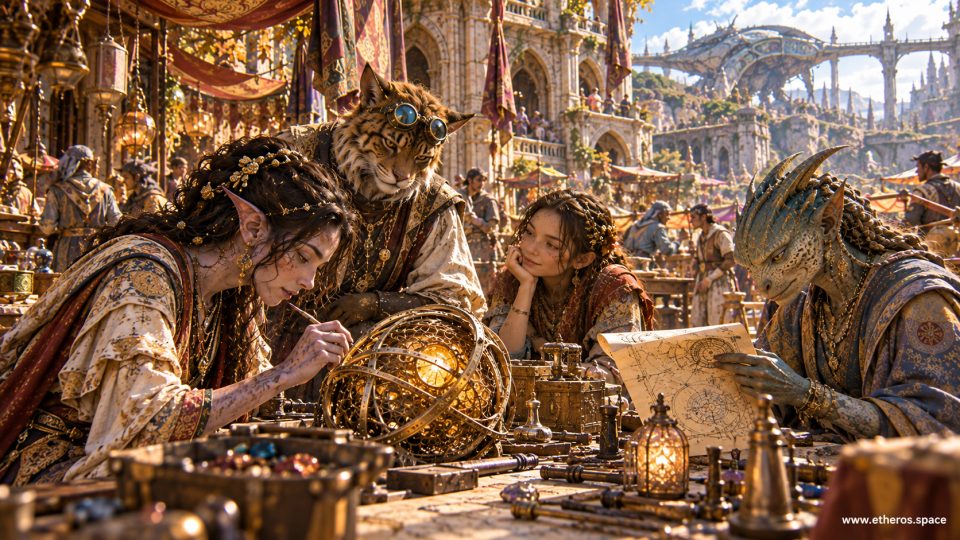
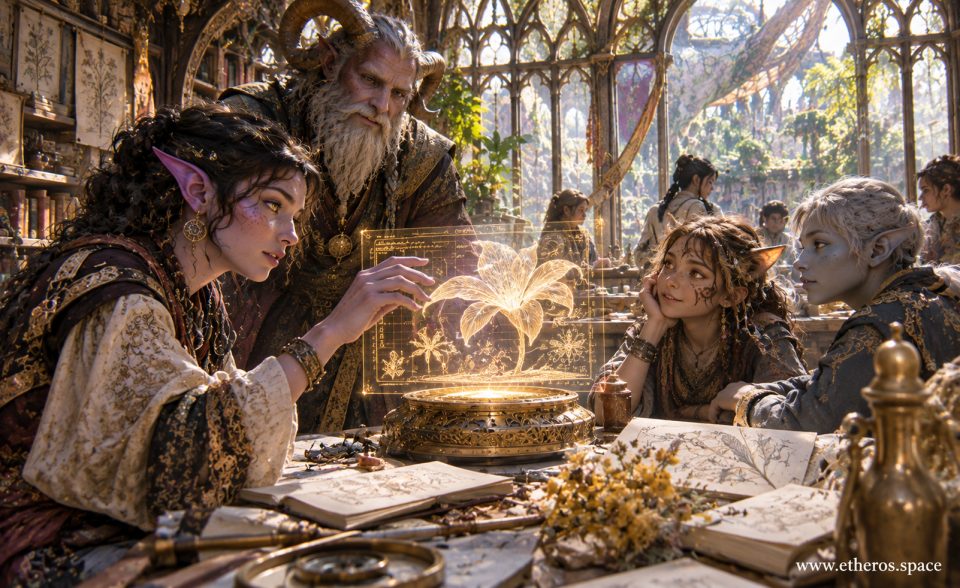
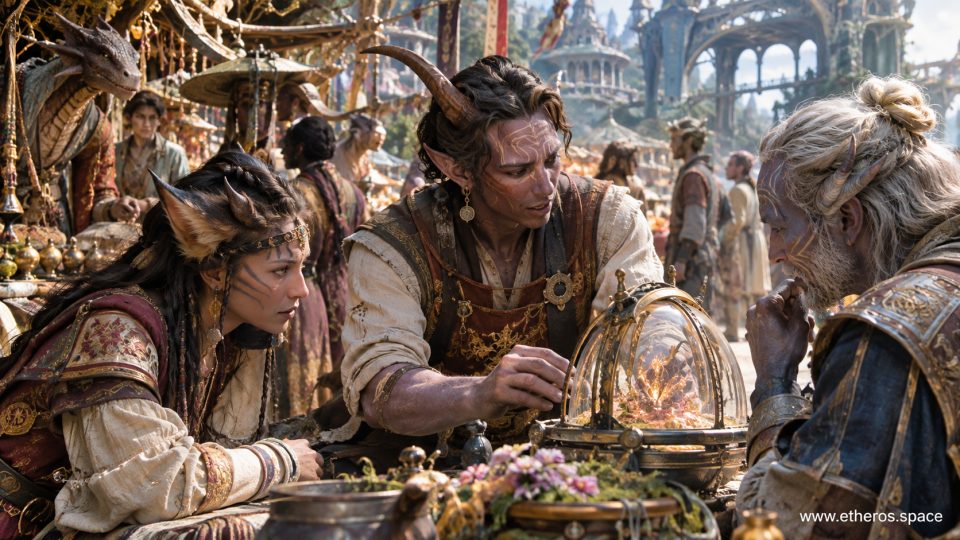
Under the white arches of the Saffron Arcade, Yarek set a glass dome between the flower pots and the brass measuring cups. Inside it, a small living cluster of amber filaments glowed like embers caught in an unopened seed. A narrow bronze rim held the vessel in place. When he touched its adjustment pin, the filaments brightened. That much anyone could see.
Nivra leaned in from his left. The dark-haired, sharp-eared young resident had traced the winding street patterns of the upper district for years, looking for routes that avoided the clouds of dry grinding dust released at midday. She wore an embroidered travelling mantle and a gold circlet whose delicate points caught in her hair. The dust was not always visible. Its consequences, she said, were.
On the other side of the table stood Ossan, his white hair bound loosely above the worn collar of his ceremonial coat. He had spent more than three generations teaching families to judge the wind by the odor of the stone-cutting yards. One hand rested near his chin while he watched the light. Behind them, shoppers went on with their errands. A long-scaled stall guardian lifted its head among the hanging brass lamps, briefly more interested in the discussion than in the passing crowd.
Yarek called the apparatus a breathglass. The filaments were fed by stored sugars and a small exchange of salts beneath the perforated base. Their color responded, he believed, to certain fine particles in the air. No invisible spirits were imprisoned inside; no prophecy was being spoken. Something living was changing in response to its surroundings. The difficulty lay in determining what that change actually meant.
'You are asking us to trust a light,' Ossan said.
'I am asking us to measure when it shines,' Yarek replied.
Nivra pointed to the flowers around the dome. Their pollen was as fine as the pale dust that collected on her shutters. Could the instrument tell one from the other? Would it flare in a garden where the air was harmless, or stay quiet beside a cutting shed whose grit entered the lungs of children? Yarek did not know. He had compared three vessels in his own room, not a season of air over Darsun. His records were neat, but his evidence was small.
That answer altered the conversation. Ossan had come expecting another merchant's marvel, complete with promises no buyer could test. Instead he heard an uncertainty honestly admitted. He began asking better questions. How often must the living cluster be fed? Who would maintain it when the maker traveled? Would a cracked dome scatter luminous material into a home? And if a warning proved useful, why should those working closest to the grinders be the last able to afford it?
Yarek glanced past the counter at the busy arcade. A stall could support only a few costly vessels. A city, however, already possessed places where a trial might be observed without buying anything: the public stairwells, shared cooking courts and the covered passage beside the stoneworks. Nivra knew the winds that moved through them. Ossan knew the households whose old-fashioned observations were dismissed because their owners could not write a scholar's report.
They agreed to attempt something less spectacular than a sale. Yarek would lend three breathglasses for one turning of the dry season. Nivra would record the hour, the weather and the condition of the air by several ordinary means, keeping a separate record whenever the glowing organism disagreed with the other signs. Ossan would invite the residents to report discomfort without forcing them to identify themselves publicly. The observations would be posted where workers could read them, with clear markings for 'uncertain' and 'not yet tested.' No household would be told that the light alone could guarantee safety.
The bargain did not make the apparatus perfect. The city still needed cleaner work practices, safer ducts and people willing to listen. A warning could not stop the wind. Nor could a luminous seed replace the judgment of those who lived beneath the dust every day. But it might help a neighborhood ask its questions before the harm was done.
Near closing, Yarek turned the adjustment pin once more. The tiny amber cluster bloomed against the curve of glass. Nivra smiled—not because the light had proved its purpose, but because there would be witnesses to what it did next. Ossan remained watchful, as he always had. He asked for the first blank ledger and the simplest possible instructions.
Beyond their small table, the market continued to sell its wonders. This one had not been sold. It had become a shared experiment, with all the uncertainty and responsibility that sharing required.
And, for the first evening anyone could remember, the question passing between the stalls was not how brightly the new lamp shone, but whether tomorrow's air would be different, and who would be there to notice.