The Sky Did Not Belong to the Gate
20261105T062906995666Z_024percent.png
Story
THE SKY DID NOT BELONG TO THE GATE
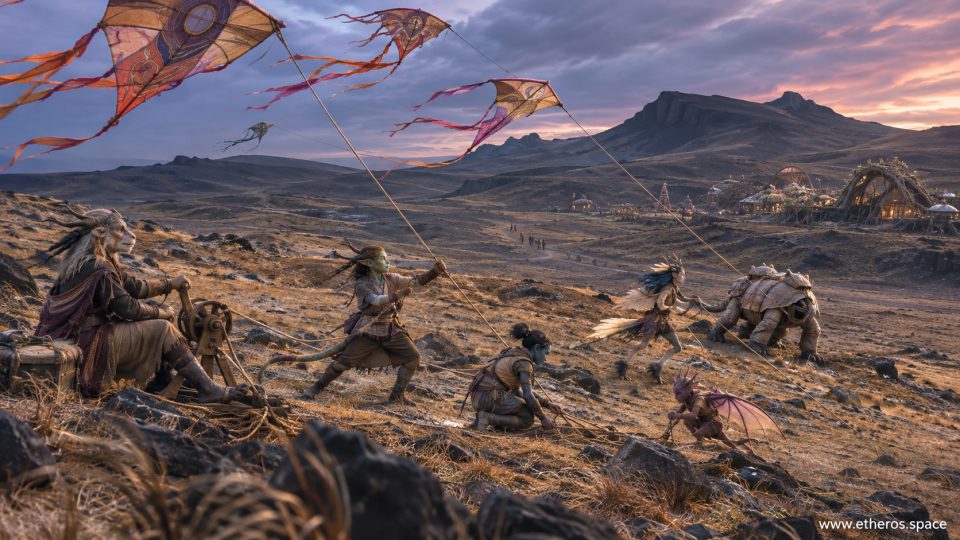
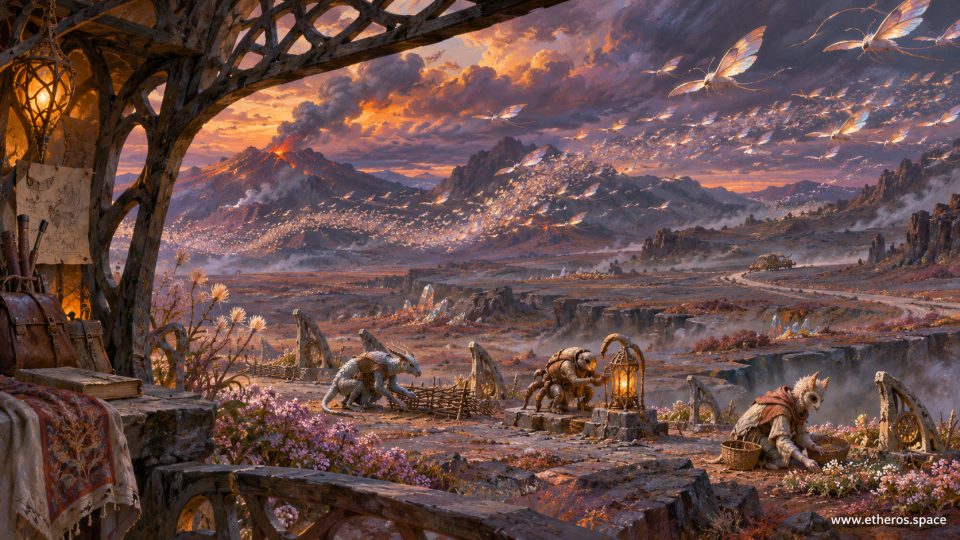
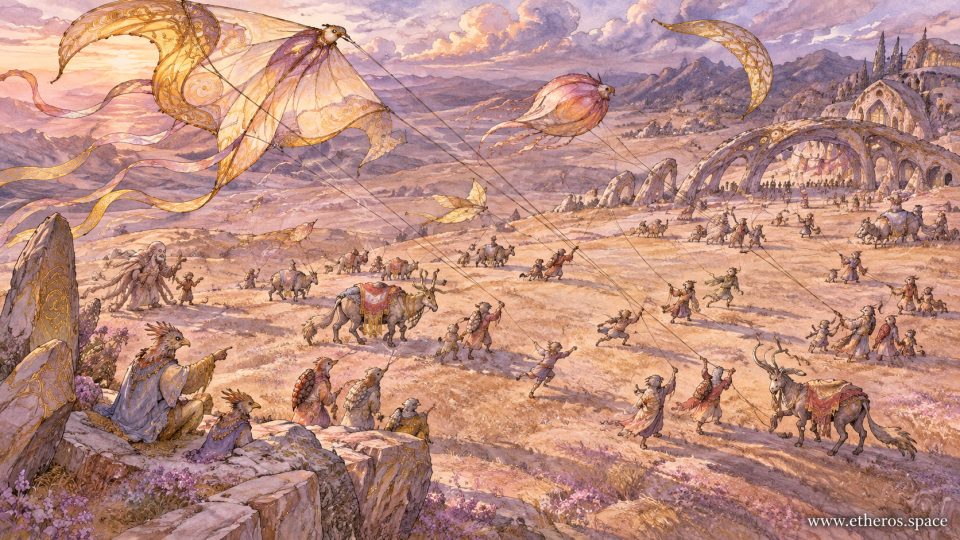
The wind came over the dry uplands of Irrelune with enough force to turn an unwary traveler around. It bent the straw-colored grass flat between stone shelves and drew lavender dust through the low flowers. The festival had no walls. On the far ridge, an old civic arch stood open like an unfinished ring, and beyond it the domed houses of the highland town caught the last copper light of evening. Hundreds of residents were already moving across the slope, some on foot and others beside decorated, horned pack animals. Above them, enormous leaf-shaped sails tugged against their lines.
From the rocks at the western edge, Urel watched the nearest golden sail turn its translucent belly toward the sunset. The old bird-faced maker wore a blue mantle faded at the shoulders. A young crested relative, Meni, sat beside him with both hands folded around a spare coil. Urel pointed not at the sail but at the narrow place where its lower rib changed direction. When the wind pressed against the membrane, that small curve carried part of the load toward the three nearest lines. If the rib snapped, silk would tear. If the lines broke, people below could be hurt.
Meni knew the calculation. What she did not know was why Urel had insisted on coming this year. His hands had trembled at the weaving frame through the cold season. For twenty-six festivals he had signed the primary flight record, and lately his apprentices had been asking whether a line could be measured more precisely by the new tension gauges. He thought that was sensible. He also feared that if the record contained only measurements, the names of the people who had learned the wind before gauges existed would disappear.
Down the slope a young runner named Vara leaned backward on a taut cord, legs braced against the gritty rise. Other handlers pulled from separate positions, making a broad triangle to resist the crosswind. A second huge sail, rose-colored and curled like the wing of a sleeping moth, rose behind the first. Small, birdlike fliers darted in the distance: decorative kites, not living creatures compelled to work. Their weight came from cane-veined fabric, carved hoops and the many ordinary arms below. No invisible force kept them aloft. Wind did the lifting and the people provided the resistance.
The town council had almost canceled the evening. The worn arch on the eastern ridge needed repairs, and the festival's public fund was the obvious place to find the money. Traders had proposed charging for the upper launch ground; its vantage was better, its stones safer, and visitors might pay more for the privilege. A few residents argued that everyone would still see the kites from below. Others answered that being allowed to watch was not the same as being allowed to take part. Children whose families had sold tools to settle debts could no longer afford a spool, much less admission.
Urel had stayed silent through those meetings. He had kept the same worn pattern book since his first apprenticeship, its pages stained with resin and fine dust. On the morning of the festival he carried it to the council and offered his most profitable private design for public use on one condition: any resident could join the launch crew after a free lesson in safe handling. A trader offered replacement ribs and a cart. The stonekeepers agreed to rope off the unstable archway rather than shut the entire plateau. The council committed to publish the repair costs after the festival, so generosity would not hide an unpaid obligation. No one got everything they wanted. That was why the decision held.
Now Meni watched a small group struggle with an overloaded line near the central rise. Their sail was beautiful, but its lower cords had tangled against a pack animal's blanket. The animal shook its antlers, stopped, and waited while its keeper loosened the knot. Vara called the nearest handlers away from the crossing. The membrane dipped; an old woman on the slope let out a disappointed sound. Then the load slackened, the knot was freed and the great golden wing lifted again. People cheered not because danger had passed dramatically, but because the young crew had chosen to pause rather than pretend it was safe.
Urel closed his book. Meni had been asking to add local terms to the diagrams: the cliff dwellers' name for a changing wind, the caravan families' signal for a twisting tether, the short warning call used by children who rode the ridge paths. Some words could not be translated into the council's standard measures. They were not therefore less accurate. They held generations of weather, accidents, luck, and patient correction. Urel decided the next page would leave space for them all, even for terms whose meaning he still disputed.
The long silk ribbons shifted to violet as the sun sank. Near the distant arch, more families arrived carrying supper pots and folded blankets. Several had traveled from settlements that rarely agreed on anything. Tonight they stood on different patches of ground and held the same moving sky between them. Urel handed Meni the book, because the lines would need tending and the book would need another keeper. She asked whose name should go first on the new page.
"The ones holding it," he said.
And while the gold wing filled with wind again, no one on the plateau looked toward the gate to ask permission to look up.